
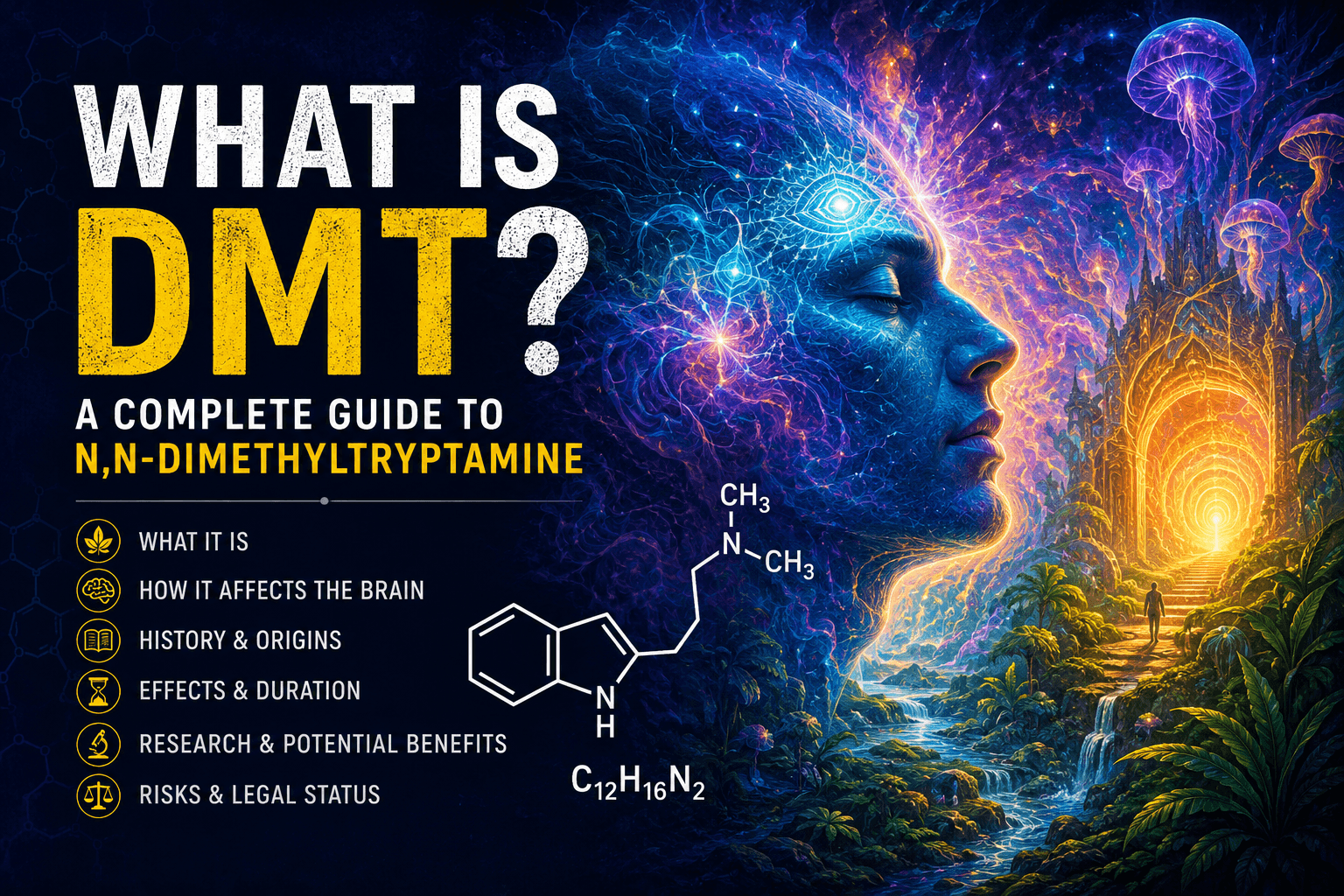
DMT, short for N,N-dimethyltryptamine, is a naturally occurring psychedelic compound that has attracted growing interest from scientists, historians, and people interested in psychedelic research. It is found in a variety of plants and animals and is one of the main psychoactive compounds associated with ayahuasca, a traditional plant-based preparation with a long history of ceremonial use in South America.
Unlike many substances that have only recently attracted scientific attention, DMT has been studied for decades. Researchers have investigated its chemistry, effects on the brain, metabolism, relationship with serotonin receptors, and potential therapeutic applications.
Interest in DMT has increased further as modern psychedelic research has expanded. Early-stage clinical studies are examining DMT in controlled research settings, including investigations into its safety, pharmacology, and possible applications in mental health. However, much remains unknown, and researchers continue to emphasize the need for larger and better-controlled studies.
In this guide, we’ll explain what DMT is, where it comes from, how it interacts with the brain, its history, relationship with ayahuasca, reported effects, risks, current research, and legal considerations.
What Does DMT Stand For?
DMT stands for N,N-dimethyltryptamine.
It belongs to a group of naturally occurring compounds known as tryptamines. Chemically, DMT contains a structure related to tryptamine and shares some structural characteristics with other psychedelic compounds, including psilocybin and LSD.
DMT is often described as an indole alkaloid because of its chemical structure. It occurs naturally in numerous plant species and has also been detected in animals.
One of the unusual aspects of DMT is that related research has investigated its presence in mammals, including humans. Scientists have explored whether naturally occurring DMT may have a biological role in the body, although its precise physiological function remains unresolved.
That distinction is important: finding DMT or pathways capable of producing it in biological systems does not mean scientists have established that naturally occurring DMT is responsible for particular human experiences or states.
Where Does DMT Come From?
DMT occurs naturally in a variety of plants and animals.
Historically, DMT became particularly well known because of its connection with ayahuasca, a traditional South American preparation made from combinations of plants. Some ayahuasca preparations contain plants that provide DMT alongside plants containing compounds that affect how DMT is metabolized.
DMT can also be produced synthetically in laboratory settings. The United States Drug Enforcement Administration notes that synthetic DMT has been known since the early twentieth century, while human use of DMT-containing preparations has a much longer history.
The fact that DMT occurs naturally does not automatically make every DMT-containing product safe or legal. Natural occurrence and legal status are separate issues.
A Brief History of DMT
Modern scientific interest in DMT dates back to the twentieth century, although DMT-containing plants had been used in traditional practices long before researchers isolated and studied the compound.
The compound was first synthesized in 1931, according to the DEA. Its psychedelic properties were later investigated in the 1950s, with researcher Stephen Szára playing an important role in early human research.
DMT subsequently became part of the broader scientific investigation into psychedelic compounds during the twentieth century.
Research declined or became more difficult in many places following changes in drug policy. In more recent years, however, renewed interest in psychedelic science has led researchers to revisit DMT using modern clinical and neurobiological methods.
This renewed research is one reason DMT has become increasingly discussed outside traditional psychedelic communities.
How Does DMT Affect the Brain?
One of the most important questions surrounding DMT is how it produces such profound changes in perception and consciousness.
Research indicates that DMT interacts with several serotonin-related receptors, including 5-HT2A, a receptor strongly associated with the effects of classic serotonergic psychedelics. DMT also interacts with other biological systems, which researchers continue to investigate.
The 5-HT2A receptor is particularly important because activation of this receptor is associated with changes in sensory processing, perception, cognition, and consciousness.
However, DMT’s pharmacology is more complicated than simply saying that it “affects serotonin.”
Researchers have investigated additional receptor systems and possible interactions involving sigma-1 receptors and other biological pathways. Some recent research has also examined whether endogenous DMT could have a physiological role within the nervous system.
Scientists are still working to determine exactly how these mechanisms relate to the subjective effects associated with DMT.
What Does DMT Feel Like?
Reported DMT experiences can be extremely intense and can involve dramatic changes in perception, thoughts, emotions, and the sense of self.
Scientific literature describes psychedelic effects that can include visual and auditory alterations, changes in the perception of time and space, unusual thought patterns, intense emotional experiences, and changes in one’s sense of identity or surroundings.
Some people describe highly immersive experiences involving complex imagery or a strong sense of entering an unfamiliar environment. Others report experiences that are confusing, frightening, emotionally overwhelming, or difficult to interpret.
Individual experiences can vary substantially.
Factors such as a person’s psychological state, physical health, environment, expectations, other substances or medications, and the specific circumstances of exposure can influence the experience.
Because of this variability, descriptions found online should not be treated as guarantees of what another person will experience.
How Long Does DMT Last?
DMT is generally associated with a relatively short-lived psychedelic experience compared with some other classic psychedelics, although the exact duration depends on the circumstances and route of exposure.
Modern pharmacokinetic research has found that DMT is rapidly metabolized and eliminated from the body. A 2025 systematic review of human pharmacokinetic research reported a DMT half-life ranging from approximately 4.8 to 19 minutes across the clinical studies reviewed. The researchers also emphasized that the available human pharmacokinetic evidence remains limited and that substantial variability exists between studies and individuals.
This rapid metabolism is an important area of scientific interest because researchers are investigating whether DMT’s short duration could eventually have advantages for controlled clinical research.
It is important, however, to distinguish pharmacokinetic measurements from the subjective experience itself. The amount of time a substance remains detectable or measurable in the body is not necessarily identical to how long someone feels psychological or perceptual effects.
DMT and Ayahuasca: What’s the Connection?
DMT and ayahuasca are closely connected, but they are not the same thing.
DMT is a specific chemical compound. Ayahuasca is a traditional plant-based preparation that can contain DMT along with other compounds.
This distinction is important when reading about psychedelic research.
DMT is rapidly broken down by monoamine oxidase enzymes when taken through certain routes. Traditional ayahuasca preparations combine DMT-containing plants with plants containing compounds that inhibit monoamine oxidase, changing the pharmacological profile of the preparation.
Ayahuasca therefore cannot simply be treated as another name for DMT.
The cultural history is also different. Ayahuasca has longstanding ceremonial and religious traditions in parts of South America, while modern scientific research has examined isolated DMT as a pharmacological compound.
Is DMT Naturally Produced in the Human Body?
This is one of the most debated questions in DMT research.
Researchers have investigated whether humans and other mammals can produce DMT naturally. Studies have identified biochemical pathways associated with DMT production, and recent reviews continue to examine its possible biological significance.
However, the existence of endogenous DMT does not establish many of the popular claims sometimes made online about its role in dreams, near-death experiences, or other altered states.
Those ideas remain scientifically uncertain.
A 2025 review highlighted continuing research into DMT’s possible roles in neuroplasticity, cellular signaling, and other physiological processes while emphasizing the need for additional research.
For that reason, claims about endogenous DMT should be separated into what has been demonstrated experimentally and what remains hypothetical.
What Are the Potential Risks of DMT?
DMT is a powerful psychoactive compound, and its effects are not universally positive.
Research has documented changes in cardiovascular measures, including increases in heart rate and blood pressure, particularly in controlled experimental settings. Other reported effects can include dizziness, nausea, agitation, anxiety, confusion, and intense psychological experiences.
A 2025 systematic review of early-phase DMT clinical trials found that cardiovascular changes were observed at higher exposures in intravenous studies, while some studies involving other research routes reported effects such as nausea, dizziness, throat discomfort, or respiratory irritation. The review found no serious adverse events in the limited trials it analyzed, but it also stressed that the evidence base remains small.
This is an important point.
Early clinical findings should not be interpreted as proof that DMT is risk-free.
Clinical trials involve carefully selected participants, controlled environments, medical monitoring, defined research protocols, and exclusion criteria. Those conditions may be very different from uncontrolled or unsupervised circumstances.
Anyone with concerns about mental health, cardiovascular health, medications, or possible substance interactions should speak with a qualified healthcare professional.
Is DMT Addictive?
DMT is generally not considered to have the same pattern of compulsive use associated with many conventional addictive substances.
However, that does not mean it is completely without psychological or behavioral risks.
Psychedelic experiences can be powerful, and some people may experience anxiety, distress, confusion, or other psychological difficulties. Research into the long-term effects of repeated DMT exposure is also much less developed than research involving many established medicines and substances.
Therefore, statements that DMT is simply “safe because it isn’t addictive” are an oversimplification.
Is DMT Being Studied for Medical Use?
Yes.
Modern researchers are investigating DMT’s potential therapeutic applications, particularly in the field of mental health.
One area of interest is depression. A 2025 systematic review examined early-phase clinical trials involving DMT in healthy volunteers and people with major depressive disorder. The researchers concluded that early findings were promising enough to justify further research, but emphasized the need for larger, well-controlled trials before conclusions about efficacy and long-term safety can be made.
Other research has investigated DMT’s pharmacokinetics, subjective effects, receptor activity, and potential neurological mechanisms.
A 2025 systematic review of clinical pharmacokinetics analyzed 13 publications covering eight datasets and found considerable variability in DMT exposure and metabolism. The authors concluded that additional studies are needed to better understand differences between individuals and administration approaches.
This is an exciting area of science, but it is still research, not established medical treatment.
What Is the Difference Between DMT and 5-MeO-DMT?
DMT and 5-MeO-DMT are related but distinct psychedelic compounds.
DMT refers to N,N-dimethyltryptamine, while 5-MeO-DMT refers to 5-methoxy-N,N-dimethyltryptamine.
The additional methoxy group changes their pharmacological properties. Research indicates that 5-MeO-DMT has a particularly strong relationship with serotonin receptors including 5-HT1A and 5-HT2A.
Because their chemistry, pharmacology, and subjective effects are not identical, the two compounds should not be treated as interchangeable.
This is an important distinction for anyone researching psychedelics online.
Is DMT Legal?
DMT’s legal status varies by country and jurisdiction.
For example, the United States DEA currently classifies DMT as a Schedule I controlled substance under U.S. federal law.
However, laws surrounding DMT, DMT-containing plants, traditional preparations, research, religious use, and analogues can vary significantly between countries.
Anyone researching the legal status of DMT should therefore check the current laws of the specific country or jurisdiction rather than relying on a general statement found online.
Legal regulations can also change over time.
DMT and Modern Psychedelic Research
DMT is now part of a much broader scientific movement investigating psychedelic compounds.
Researchers are studying DMT because its pharmacology and relatively short duration make it scientifically interesting. Current research includes human pharmacokinetics, safety, subjective effects, brain mechanisms, and potential therapeutic applications.
A 2025 randomized, double-blind clinical trial examined vaporized DMT under controlled conditions, representing another step toward understanding its safety, tolerability, and subjective effects in humans.
Nevertheless, the field is still developing.
The most responsible way to discuss DMT is to distinguish between established findings, preliminary evidence, historical claims, and hypotheses that scientists are still testing.
Final Thoughts on DMT
DMT, or N,N-dimethyltryptamine, is one of the most fascinating and heavily discussed compounds in modern psychedelic research.
It is a naturally occurring tryptamine found across numerous plant and animal species, has a long connection with traditional ayahuasca practices, and has been studied scientifically for decades. Modern researchers are now revisiting DMT using clinical pharmacology, neuroscience, and controlled human trials.
At the same time, many popular claims about DMT remain unproven. Questions surrounding endogenous DMT, consciousness, long-term effects, and therapeutic applications continue to require scientific investigation.
For readers interested in learning more about DMT, psychedelics, and chocolate-related products, explore Portal Chocolate Bars for additional information and related content.
The most important takeaway is simple: DMT is a powerful psychedelic compound with a complex history and pharmacology, and modern science is still working to understand its full effects and potential.
Frequently Asked Questions About DMT
1. What is DMT?
DMT stands for N,N-dimethyltryptamine. It is a naturally occurring psychedelic compound found in various plants and animals and is one of the primary psychoactive compounds associated with ayahuasca. Researchers study DMT’s effects on the brain, pharmacology, safety, and potential therapeutic applications.
2. What does DMT do?
DMT can produce profound changes in perception, cognition, emotion, time perception, and the sense of self. Scientific research associates its psychedelic effects with activity at serotonin receptors, particularly the 5-HT2A receptor.
3. How long does DMT last?
DMT is generally associated with a relatively short-lived psychedelic experience, although duration depends on the circumstances and route of exposure. Pharmacokinetic research shows that DMT is rapidly metabolized, with a reported human half-life of approximately 4.8 to 19 minutes across studies reviewed in 2025.
4. Is DMT naturally occurring?
Yes. DMT has been identified in numerous plant and animal species. Researchers have also investigated DMT-related biochemical pathways in mammals, including humans, although its precise natural biological function remains uncertain.
5. Is DMT the same as ayahuasca?
No. DMT is a chemical compound, while ayahuasca is a traditional plant-based preparation that can contain DMT along with other compounds. Their pharmacology and cultural histories should therefore be considered separately.
6. Is DMT being studied by scientists?
Yes. Researchers are studying DMT’s pharmacology, safety, pharmacokinetics, subjective effects, brain mechanisms, and potential therapeutic applications. Early clinical research is promising but remains limited, so larger and longer-term studies are still needed.
Leave a Reply