
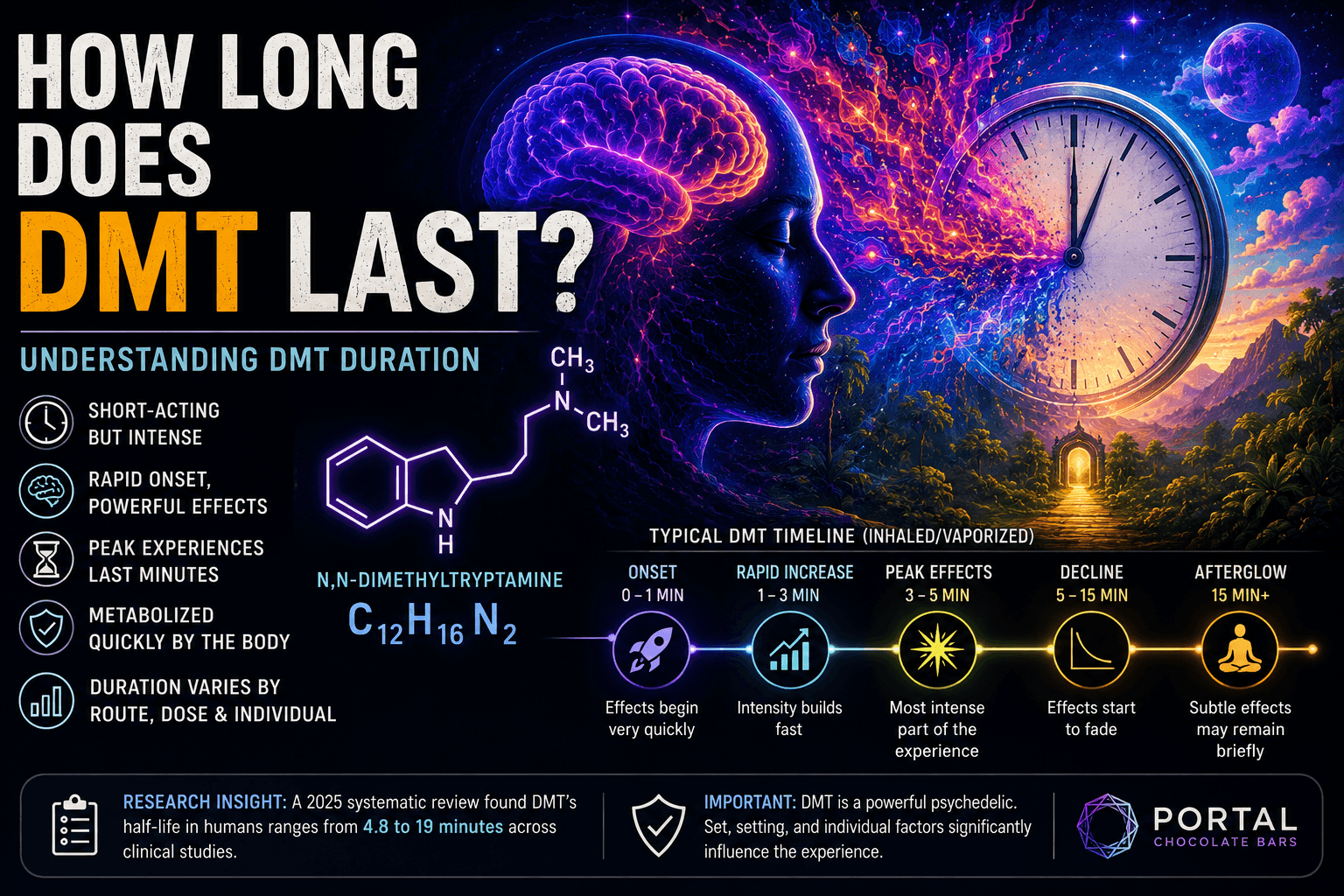
How long does DMT last? This is one of the most common questions people ask when researching N,N-dimethyltryptamine, a powerful psychedelic compound that can produce profound changes in perception, thoughts, emotions, and consciousness.
DMT has a reputation for producing an intense psychedelic experience that is relatively short compared with many other classic psychedelics. However, the answer is more complicated than simply giving one number. The duration can vary depending on the form of DMT, the route of administration, individual biology, and the difference between the time a substance remains in the body and the time its psychological effects are noticeable.
Recent research has helped scientists understand this distinction more clearly. A 2025 systematic review of human DMT pharmacokinetics found that DMT is eliminated rapidly, with reported half-lives ranging from 4.8 to 19 minutes across the clinical studies reviewed.
At the same time, researchers continue to investigate how the concentration of DMT in the body relates to the subjective experience.
In this guide, we’ll explain DMT Duration, why the duration can vary, how DMT compares with other psychedelics, what research says about its metabolism, and why pharmacokinetic duration is not exactly the same as the duration of a person’s experience.
How Long Does DMT Last?
So, how long does DMT last?
There is no single answer that applies to every DMT preparation or research setting. However, DMT is generally considered a short-acting psychedelic, particularly in clinical research involving inhaled or intravenous administration.
For example, a 2025 randomized, double-blind clinical trial described vaporized DMT as having a short duration and investigated its subjective and physiological effects under controlled conditions. The study included 25 healthy participants and found that DMT produced profound altered states of consciousness, while the reported adverse events were predominantly mild and transient.
Researchers have also studied intravenous DMT. Earlier controlled research found that acute psychedelic effects could begin very quickly and reach peak intensity within minutes under certain intravenous conditions.
Therefore, when people ask DMT Duration, it is important to specify what type of duration they mean.
There are at least three different measurements:
- Onset — how quickly effects begin.
- Subjective duration — how long the experience feels noticeable.
- Pharmacokinetic duration — how long DMT and its metabolites remain in the body.
These measurements overlap, but they are not identical.
Why Does DMT Have Such a Short Duration?
DMT has a relatively short duration because the body processes the compound rapidly.
The human pharmacokinetic literature shows that DMT undergoes rapid metabolism and elimination. A 2025 systematic review analyzed 13 publications covering eight distinct datasets and found a DMT half-life ranging from approximately 4.8 to 19 minutes.
The researchers also found evidence of extensive redistribution of DMT into other tissues and described a biphasic elimination profile.
In simple terms, the body does not leave DMT circulating at the same concentration for a long period. Instead, metabolic processes quickly change the amount of active compound available.
However, a short half-life does not mean that every psychological effect disappears at exactly the same time.
The brain and body respond to changing concentrations in complex ways. Furthermore, the subjective experience involves neural activity, perception, emotion, memory, and attention. Consequently, the experience can feel different from what a pharmacokinetic graph might suggest.
DMT Duration Depends on the Route of Administration
One of the most important factors affecting how long DMT lasts is the route through which it enters the body.
Different routes can change how quickly DMT reaches the bloodstream, how much of the compound reaches circulation, how quickly effects begin, and how long measurable effects continue.
Researchers have studied several routes in clinical settings, including intravenous and inhaled administration. These studies do not necessarily produce identical time courses.
For example, a controlled 2025 trial of vaporized DMT described a short duration and observed strong subjective effects alongside temporary physiological changes.
Meanwhile, pharmacokinetic research involving intravenous administration has shown rapid changes in DMT concentrations and effects. A 2025 systematic review found considerable variability between different administration schemes and emphasized that the available human pharmacokinetic evidence remains limited.
Because of these differences, it would be misleading to give one duration as a universal answer.
DMT Onset vs. DMT Duration
People sometimes confuse how quickly DMT begins working with how long DMT lasts.
These are different questions.
Onset refers to the period between exposure and the appearance of noticeable effects. Duration refers to the period over which effects remain noticeable.
Some clinical studies have reported extremely rapid onset with certain research administration methods. For example, a randomized placebo-controlled study of intravenous DMT found that intense psychedelic effects could peak within approximately two minutes under the study conditions.
That rapid onset contributes to DMT’s distinctive pharmacological profile.
However, the speed of onset does not automatically determine the complete duration of the experience.
The body continues to metabolize the compound after peak effects occur, and subjective effects can change gradually rather than stopping at a single precise moment.
How Long Do the Main DMT Effects Last?
The strongest DMT effects are generally associated with the period when DMT concentrations and acute psychedelic activity are highest.
During this period, research participants can experience substantial changes in perception, emotions, cognition, time awareness, and the sense of self.
After the peak, the intensity generally decreases as the acute effects subside.
However, the exact timeline can differ between individuals and research protocols. Researchers therefore avoid presenting one universal timetable as though every person will experience exactly the same progression.
This distinction matters because online discussions often present DMT duration as a fixed number.
Scientific research provides a more nuanced picture.
Clinical studies measure factors such as blood concentrations, subjective intensity, cardiovascular responses, and psychological effects. These measurements help researchers understand the relationship between the amount of DMT in the body and the experience reported by participants.
Does DMT Stay in the Body for a Long Time?
DMT is rapidly metabolized, but that does not mean every molecule disappears immediately.
The body converts DMT into metabolites, including indole-3-acetic acid (IAA). The 2025 pharmacokinetic review found rapid metabolism and noted that the timing of IAA concentrations was similar to that of DMT in the studies examined.
This process helps explain why DMT has such a short pharmacological profile.
However, it is important to distinguish between:
- The presence of DMT in the bloodstream
- The presence of metabolites
- The duration of subjective effects
- The time required for the body to return to baseline
These are not necessarily identical.
Therefore, asking how long DMT lasts in the body requires a different answer from asking how long the psychedelic experience lasts.
Can DMT Effects Continue After the Main Experience?
Yes, some people may notice effects after the most intense phase has passed.
The character of these after-effects can vary. Some people report feeling emotionally reflective or mentally stimulated, while others may feel tired, unsettled, or simply ready to return to their normal routine.
Controlled research also monitors physiological measures after the acute effects because researchers want to understand the complete safety profile rather than only the peak experience.
A 2025 systematic review of early-phase clinical trials found temporary increases in cardiovascular measures in some DMT studies, particularly at higher exposures in intravenous research. These changes resolved relatively quickly in the studies reviewed.
Consequently, the end of the most intense subjective effects does not necessarily represent the exact moment when every physical or psychological effect has disappeared.
How Long Does DMT Last Compared With LSD?
DMT generally has a much shorter acute time course than LSD.
LSD is known for producing psychedelic effects that can continue for many hours, whereas DMT is typically described as short-acting in clinical research.
This difference results partly from differences in pharmacology and metabolism.
Both substances can produce changes in perception, cognition, emotions, and consciousness. Nevertheless, their time profiles are substantially different.
For someone researching psychedelic science, this makes DMT particularly interesting to scientists. Researchers can investigate profound alterations in consciousness without necessarily requiring the same lengthy acute observation period associated with longer-acting psychedelics.
Recent clinical studies have specifically explored whether DMT’s short duration could have advantages for controlled therapeutic research.
How Long Does DMT Last Compared With Psilocybin?
DMT also generally has a shorter acute duration than psilocybin.
Psilocybin is converted into psilocin and typically produces a psychedelic experience lasting considerably longer than the acute effects associated with rapidly administered DMT.
This difference has become particularly relevant in modern psychedelic research.
Researchers are investigating whether short-acting psychedelics such as DMT could offer practical advantages in controlled clinical environments. A 2025 phase 2a clinical trial investigated vaporized DMT in people with treatment-resistant depression and reported rapid antidepressant effects that persisted beyond the short acute psychedelic period.
That finding highlights an important scientific distinction:
A psychedelic experience can be short while some measurable effects studied afterward may last much longer.
Researchers are still investigating why that happens and how reliably it can be reproduced.
Does the Short Duration Make DMT Safe?
Not necessarily.
The fact that DMT has a relatively short acute duration does not automatically make it safe for everyone.
DMT can produce intense psychological effects and temporary physiological changes. Clinical studies therefore use controlled environments, participant screening, monitoring, and medical protocols.
A 2025 systematic review of early clinical trials found that DMT produced temporary cardiovascular changes in some study settings. The review also emphasized the limited size of the existing evidence base and the need for additional research.
Therefore, people should not assume that a short duration eliminates potential risks.
Individual medical history, psychiatric conditions, medications, and other factors can influence safety.
Anyone with concerns about DMT or potential substance interactions should consult a qualified healthcare professional.
Why Does DMT Duration Matter to Researchers?
The short duration of DMT has become one of the reasons scientists continue to investigate it.
Many traditional psychedelic studies involve substances that can produce effects lasting several hours. That can create logistical challenges for clinical research because participants may require prolonged monitoring.
DMT presents a different model.
Researchers can investigate an intense psychedelic state with a comparatively short acute time course. This may allow scientists to study psychedelic mechanisms while potentially reducing the length of supervised sessions.
A 2025 randomized clinical trial specifically described vaporized DMT’s short duration as one reason researchers are interested in its potential clinical applications.
However, researchers still need larger studies to determine whether this theoretical advantage translates into meaningful clinical benefits.
Can DMT Duration Be Extended?
Researchers have investigated different formulations and administration approaches that alter DMT’s pharmacokinetic profile.
For example, one 2025 randomized controlled study investigated a DMT and harmine formulation designed to produce a longer-lasting pharmacological profile. The researchers reported acute psychological effects lasting approximately 2–3 hours under that specific experimental formulation.
This is an important scientific finding because it demonstrates that DMT’s duration is not an immutable property of the molecule alone.
Instead, the way the compound interacts with metabolism and the formulation used can substantially change the time course.
However, research formulations should not be treated as instructions for personal use.
Their purpose is to help scientists understand pharmacology and investigate potential therapeutic applications under controlled conditions.
What Does DMT Research Say About Duration in 2026?
DMT research continues to expand.
Recent studies have examined pharmacokinetics, subjective effects, safety, continuous infusion, inhaled administration, and potential applications in psychiatry.
A 2025 systematic review found only 13 publications covering eight distinct pharmacokinetic datasets and noted significant variability between individuals and administration approaches. The authors concluded that additional research remains necessary.
At the same time, controlled clinical trials have provided more detailed information about the relationship between DMT concentration, subjective intensity, and physiological responses.
This growing evidence base will likely help researchers develop more precise models of DMT duration.
For now, the safest scientific conclusion is that DMT is generally short-acting, but its exact duration depends on the circumstances and cannot be reduced to one universal number.
What Factors Can Change DMT Duration?
Several factors can influence the observed duration of DMT effects.
Route of administration
Different routes can produce different absorption and elimination patterns.
Individual metabolism
People process substances differently. Differences in enzymes, physiology, body chemistry, and other biological factors can affect pharmacokinetics.
Formulation
Different formulations can change how quickly DMT enters and leaves the body’s circulation.
Research protocol
Clinical studies may use different administration schedules, observation periods, and measurement techniques.
Psychological experience
Subjective perception of time can change significantly during psychedelic states. Consequently, the experience may feel longer or shorter than the objective clock time.
These factors explain why a simple internet answer cannot accurately predict the exact experience for every individual.
The Difference Between DMT Half-Life and DMT Duration
This distinction deserves special attention.
Half-life describes the time required for the concentration of a substance in the body to decrease by approximately half.
Duration of effects describes how long noticeable psychological or physiological effects continue.
These measurements are related, but they are not interchangeable.
The 2025 DMT pharmacokinetic review reported a half-life of approximately 4.8–19 minutes across the studies included in its analysis.
That does not mean a person should assume the experience will last exactly one half-life or several half-lives.
Instead, researchers combine pharmacokinetic measurements with subjective reports and physiological data to understand the complete time course.
This distinction is one of the most important things to understand when searching how long does DMT last.
Final Thoughts: How Long Does DMT Last?
So, how long does DMT last?
The most accurate answer is that DMT is generally a short-acting psychedelic, particularly in clinical research involving rapidly administered forms. However, the exact duration varies according to the route of administration, formulation, individual biology, and the way researchers measure the experience.
A 2025 systematic review found a DMT half-life of approximately 4.8–19 minutes across the human pharmacokinetic studies it reviewed. Meanwhile, controlled clinical research has demonstrated that DMT can produce profound subjective effects while producing temporary physiological changes.
Most importantly, half-life should not be confused with the total duration of a psychedelic experience.
Modern research continues to explore why DMT acts so quickly, how its effects relate to blood concentrations, and whether its short acute duration could offer advantages in future psychedelic medicine.
If you want to understand the science behind DMT more broadly, read our previous guide, What Is DMT? A Complete Guide to N,N-Dimethyltryptamine, and explore more educational content from Portal Chocolate Bars.
As DMT research develops, new studies will continue to refine what scientists know about its duration, pharmacology, effects, and potential applications.
Frequently Asked Questions About DMT Duration
1. How long does DMT last?
DMT is generally considered a short-acting psychedelic, particularly when researchers study rapidly administered forms. However, the exact duration varies depending on the route, formulation, individual biology, and how researchers define the end of the experience.
2. How long does DMT stay in the body?
DMT is rapidly metabolized. A 2025 systematic review of human pharmacokinetic studies reported a half-life of approximately 4.8–19 minutes, although the researchers emphasized substantial variability between studies and individuals.
3. Why does DMT have such a short duration?
DMT undergoes rapid metabolism and elimination. Researchers have found that the compound is processed quickly by the body, which contributes to its short pharmacokinetic profile.
4. Does DMT last longer than LSD?
Generally, no. DMT is considered much shorter-acting than LSD. LSD can produce psychedelic effects for many hours, whereas DMT typically has a much shorter acute time course.
5. Does DMT last longer than psilocybin?
Generally, DMT has a shorter acute duration than psilocybin. However, the exact comparison depends on the specific research conditions and formulation being studied.
6. Can DMT effects last longer than the main psychedelic experience?
Yes. The strongest acute effects may subside while some physical or psychological after-effects remain noticeable. Researchers distinguish between the peak experience, the overall subjective duration, and the pharmacokinetic elimination of the compound.
Leave a Reply