
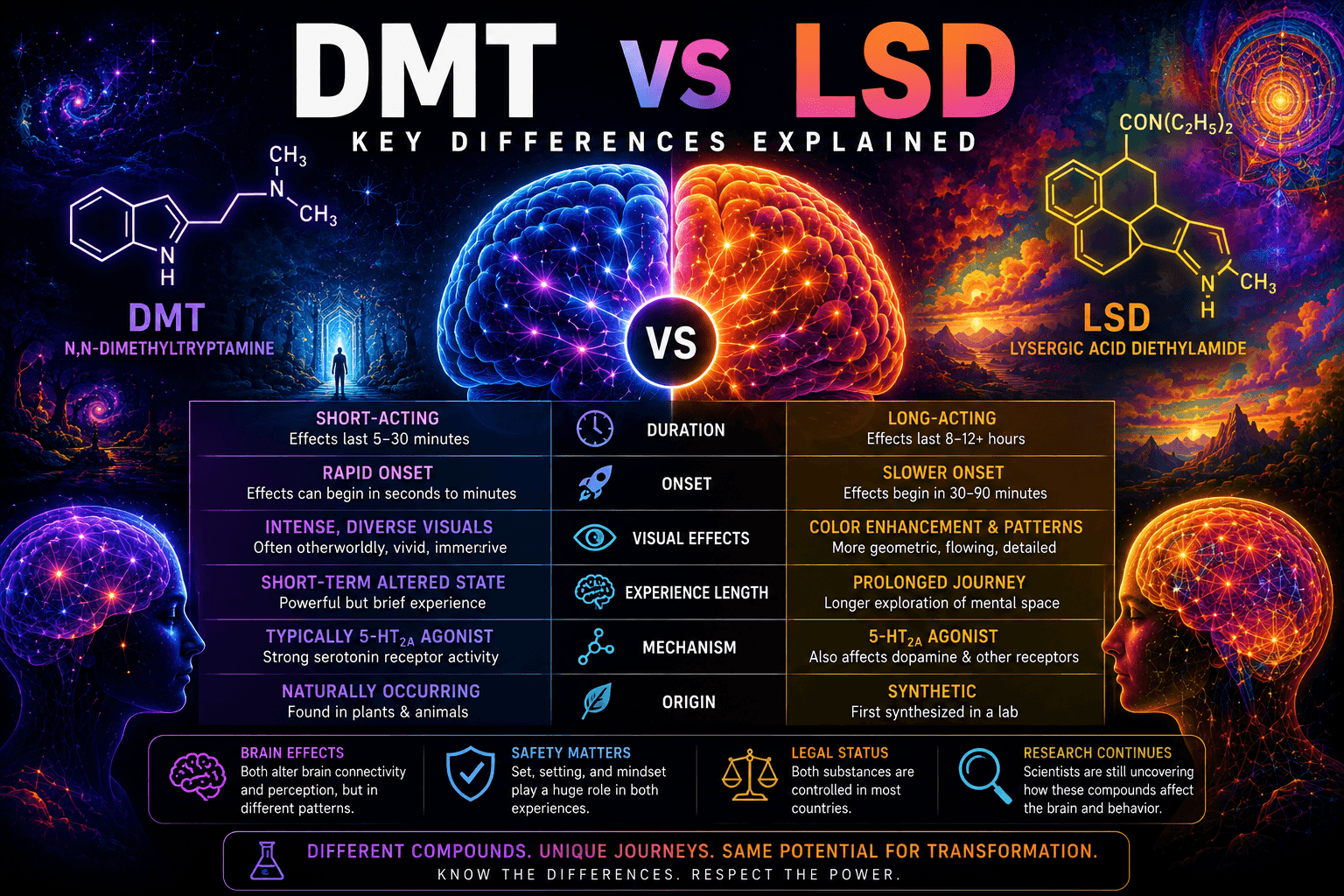
DMT vs LSD is one of the most common comparisons people make when researching classic psychedelics. Although both substances can produce profound changes in perception, cognition, emotion, and consciousness, they are chemically different compounds with very different time courses.
DMT stands for N,N-dimethyltryptamine, while LSD stands for lysergic acid diethylamide. Both belong to the broader group of serotonergic psychedelics, and both interact strongly with the 5-HT2A serotonin receptor. However, their molecular structures, pharmacokinetics, metabolism, onset, and duration differ substantially.
That difference in duration is particularly important. DMT is generally considered a short-acting psychedelic, whereas LSD is a long-acting psychedelic. A recent 2026 review specifically places N,N-DMT among short-acting psychedelics and LSD among longer-acting compounds.
Still, duration is only one part of the comparison.
So, what is the difference between DMT and LSD? How do they affect the brain? How long do they last? Are their effects similar? And what does current research actually tell us?
This guide examines DMT vs LSD from a scientific and educational perspective, including chemistry, pharmacology, brain effects, duration, subjective effects, research, safety, and legal considerations.
What Is DMT?
DMT, or N,N-dimethyltryptamine, is a naturally occurring tryptamine psychedelic.
Researchers have identified DMT in various plants and animals, and the compound has a long history of association with traditional plant preparations such as ayahuasca.
Modern researchers have also studied isolated DMT in controlled laboratory and clinical settings. These studies examine its effects on consciousness, brain connectivity, pharmacokinetics, cardiovascular responses, and potential therapeutic applications.
DMT interacts with several biological targets, but its psychedelic effects are strongly associated with activity at the 5-HT2A receptor.
Human neuroimaging studies have found that DMT can substantially alter communication between brain networks. Research has reported increased global functional connectivity alongside reduced integrity and separation within several established networks.
These changes may help explain why DMT can produce dramatic alterations in perception, time, emotions, and the sense of self.
For a deeper introduction, read our previous guide, What Is DMT? A Complete Guide to N,N-Dimethyltryptamine, on Portal Chocolate Bars.
What Is LSD?
LSD stands for lysergic acid diethylamide.
Unlike DMT, LSD is a synthetic psychedelic compound derived from lysergic acid. Researchers classify it as a classic serotonergic psychedelic because it produces its characteristic effects largely through interactions with serotonin receptors, especially 5-HT2A.
LSD has played a major role in the history of psychedelic research. Scientists have investigated its pharmacology, subjective effects, brain activity, therapeutic potential, and safety for decades.
Modern clinical research has returned to LSD as scientists investigate its possible applications in psychiatry and neuroscience.
Like DMT, LSD can alter perception, cognition, emotions, time awareness, and the sense of self.
However, the experience generally unfolds over a much longer period.
That difference becomes one of the most important points when comparing DMT vs LSD.
DMT vs LSD: The Basic Chemical Difference
The first major difference involves chemistry.
DMT: N,N-dimethyltryptamine
LSD: lysergic acid diethylamide
DMT belongs to the tryptamine family, while LSD belongs to the ergoline family.
Although their structures differ, both compounds interact with the serotonergic system.
This illustrates an important principle in pharmacology: two chemically different compounds can produce related psychological effects when they influence overlapping biological systems.
A 2024 comparative review of serotonergic psychedelics identified DMT and LSD among the classic psychedelics that act as 5-HT2A receptor agonists. The review also emphasized that these substances differ substantially in pharmacokinetics and duration.
Therefore, DMT and LSD are related in terms of psychedelic pharmacology but should not be treated as interchangeable substances.
DMT vs LSD: How Do They Affect the Brain?
One of the most important similarities in DMT vs LSD involves serotonin.
Both compounds strongly interact with the 5-HT2A receptor, which is widely distributed throughout the cerebral cortex.
Activation of 5-HT2A receptors can alter sensory processing, cognition, attention, emotional processing, and communication between brain networks.
However, researchers have found that different psychedelics can produce different patterns of brain activity even when they share important receptor targets.
Recent neuroscience research suggests that psychedelics generally increase communication between some normally separated brain networks while reducing the stability of activity within certain networks. A 2025 systematic review and meta-analysis found that serotonergic psychedelics generally strengthen between-network functional connectivity while reducing within-network connectivity.
A large 2026 mega-analysis that combined 11 resting-state fMRI datasets across five psychedelics, including DMT and LSD, also identified a common pattern of increased connectivity between higher-order networks and sensory networks.
These findings suggest that DMT and LSD share some broad neural mechanisms while still producing different time courses and individual effects.
DMT vs LSD: What Do the Experiences Feel Like?
Both DMT and LSD can produce powerful changes in consciousness.
However, people often describe their subjective experiences differently.
DMT is frequently associated with a rapid transition into an intense altered state. Research participants can experience dramatic visual changes, unusual spatial perceptions, altered time perception, emotional intensity, and changes in the sense of self.
LSD, by comparison, typically develops more gradually and lasts considerably longer. Research describes changes in visual perception, cognition, emotion, sensory processing, and self-related experience.
Nevertheless, it would be misleading to say that DMT always produces one type of experience while LSD always produces another.
A comparative review of serotonergic psychedelics found that many acute psychedelic effects overlap across compounds and suggested that duration may be one of the clearest practical differences.
Individual experiences can also vary substantially.
Psychological state, environment, expectations, individual biology, and other factors can influence how a psychedelic experience develops.
Therefore, personal reports should not be treated as universal descriptions.
DMT vs LSD: Which Lasts Longer?
This is probably the clearest difference in the entire DMT vs LSD comparison.
DMT is generally short-acting, while LSD is long-acting.
Modern pharmacokinetic research supports this distinction.
A recent systematic review of classical serotonergic psychedelics found substantial differences in pharmacokinetic profiles between compounds. LSD has a considerably longer pharmacological time course than rapidly administered DMT.
For DMT, a 2025 systematic review reported a human half-life of approximately 4.8 to 19 minutes across the clinical studies included in its analysis.
LSD has a much longer elimination half-life. A controlled pharmacokinetic study of low-dose LSD reported a mean elimination half-life of approximately 2.7 hours, although the subjective effects continued for several hours.
Importantly, half-life is not the same as subjective duration.
Half-life describes how quickly the concentration of a compound declines in the body. Subjective duration describes how long noticeable psychological effects remain.
Consequently, researchers measure both pharmacokinetics and subjective effects when comparing psychedelics.
How Long Does DMT Last?
DMT is generally considered a short-duration psychedelic when studied through rapidly acting routes in controlled research.
The acute experience can develop quickly and decline relatively quickly compared with LSD.
A 2025 pharmacokinetic review found that DMT has a short half-life, although the exact value varies across studies and administration methods.
A 2025 clinical study of vaporized DMT also described the compound as short-acting and observed strong subjective effects accompanied by temporary physiological changes.
However, researchers emphasize that the exact duration depends on the research method and route of administration.
For a deeper discussion, read our article How Long Does DMT Last? Understanding DMT Duration.
How Long Does LSD Last?
LSD generally lasts much longer than DMT.
Controlled research has demonstrated that LSD can produce measurable subjective effects for several hours. In a direct comparison of LSD and psilocybin, researchers found that LSD produced clearly longer-lasting effects than psilocybin under the study conditions.
A separate controlled study of LSD pharmacokinetics found an elimination half-life of approximately 2.7 hours in the low-dose conditions studied.
The longer time course means that researchers and clinicians must consider a substantially longer observation period when studying LSD.
This difference also makes LSD pharmacologically distinct from short-acting psychedelics such as DMT.
DMT vs LSD: Onset and Time Course
Another major difference involves how quickly the effects develop.
DMT can produce a rapid transition into an altered state under rapidly acting research conditions.
LSD generally has a slower onset and much longer progression.
The difference reflects their pharmacokinetics.
DMT reaches and leaves the bloodstream rapidly under certain administration conditions, whereas LSD remains in the body considerably longer.
Researchers have therefore become interested in short-acting psychedelics such as DMT as potential tools for studying psychedelic states in shorter controlled sessions.
At the same time, LSD’s longer duration provides researchers with a different experimental model.
Neither duration is automatically “better.”
Instead, the appropriate time course depends on the research question.
DMT vs LSD: Visual Effects
Both compounds can significantly alter visual perception.
DMT, however, is particularly associated with intense visual phenomena during acute experiences.
Human DMT studies have documented major changes in sensory processing and visual brain activity. Research involving the visual cortex has found changes in receptive-field properties during DMT exposure, providing evidence that the compound can modify how the brain processes visual information.
LSD can also produce substantial visual changes, including altered colors, patterns, shapes, depth perception, and sensory interpretation.
Therefore, both compounds can affect vision, although the experiences may differ in intensity, timing, and character.
Researchers generally avoid reducing either psychedelic to its visual effects because both substances influence broader cognitive and emotional systems.
DMT vs LSD: Time Perception
Both DMT and LSD can alter subjective time.
During psychedelic states, people may perceive time as moving faster, slower, or becoming difficult to measure.
Researchers consider this an important component of altered consciousness.
The difference between DMT and LSD becomes particularly interesting here because the subjective experience unfolds on very different objective time scales.
DMT’s short pharmacological profile can create an experience that feels highly immersive despite its brief objective duration.
LSD, by contrast, maintains altered consciousness over a substantially longer period.
Consequently, both can disrupt time perception, but they do so within very different overall time courses.
DMT vs LSD: Effects on the Sense of Self
Both DMT and LSD can alter a person’s sense of identity and self-awareness.
Researchers sometimes describe strong reductions in the ordinary sense of self as ego dissolution.
Brain-imaging studies suggest that psychedelic states can alter communication within networks associated with self-related processing.
For DMT, human imaging research has found changes involving networks and regions associated with self-processing, memory, and consciousness.
LSD research has also identified changes in large-scale brain connectivity.
A 2025 review of psychedelic neuroscience concluded that classic serotonergic psychedelics can alter both local and large-scale brain processes, although researchers still do not fully understand how these changes produce subjective experiences.
Thus, DMT and LSD share some important psychological characteristics even though their durations differ.
DMT vs LSD: Physical Effects
Both substances can produce temporary physical effects.
Research involving serotonergic psychedelics has documented changes such as:
- Increased heart rate
- Changes in blood pressure
- Dizziness
- Nausea in some settings
- Changes in body temperature
- Altered sensory awareness
- Temporary anxiety or psychological distress
The exact physical profile depends on the substance, research conditions, and individual factors.
Controlled LSD research has documented cardiovascular effects, while DMT studies have also observed temporary changes in heart rate and blood pressure.
A comparative clinical pharmacology review concluded that classic serotonergic psychedelics produce broadly comparable acute subjective and somatic effects, although their pharmacokinetics and durations differ substantially.
This is another reason why it is inaccurate to describe one substance as simply “safe” and the other as “dangerous.”
Safety depends on the individual, context, substance, and circumstances.
DMT vs LSD: Addiction and Dependence
DMT and LSD differ from many substances associated with conventional patterns of physical dependence.
Classic psychedelics generally do not produce the same pattern of compulsive use associated with strongly addictive substances.
However, that does not mean they are completely risk-free.
Both can produce powerful psychological experiences, and some people may experience anxiety, confusion, distress, or other adverse psychological effects.
Researchers therefore continue to investigate abuse liability, psychological safety, and long-term outcomes.
A review of human behavioral pharmacology emphasizes that psychedelic research must consider subjective effects, physiological responses, abuse liability, and long-term behavioral outcomes rather than focusing on a single safety measure.
DMT vs LSD: Medical Research
Both DMT and LSD have attracted renewed interest in modern psychedelic medicine.
Researchers are investigating whether psychedelic compounds could eventually contribute to treatments for conditions such as depression, anxiety, addiction, and other psychiatric disorders.
However, the evidence is not equally developed for every compound or condition.
A comparative review published in 2024 concluded that evidence for therapeutic applications remained relatively limited for DMT and LSD compared with better-established research areas.
Modern DMT studies have examined pharmacokinetics, safety, brain activity, subjective effects, and possible antidepressant applications.
LSD research has also explored mood, cognition, psychiatric symptoms, and potential therapeutic mechanisms.
Importantly, research findings should not be interpreted as proof that either substance is an established treatment for every condition being studied.
Clinical research remains an evolving field.
DMT vs LSD: Brain Research
Modern neuroscience provides another useful way to compare the two substances.
DMT studies have shown rapid changes in global brain connectivity, network organization, and visual processing.
LSD studies have also demonstrated changes in functional connectivity and communication between brain networks.
Interestingly, a large 2026 mega-analysis combining data from 11 resting-state fMRI datasets across five psychedelics, including both DMT and LSD, found common changes in brain connectivity across different psychedelic compounds. The strongest shared pattern involved increased connectivity between higher-order networks and sensory networks.
This suggests that DMT and LSD may share fundamental psychedelic mechanisms despite their different chemical structures and durations.
At the same time, scientists continue to investigate substance-specific effects.
DMT vs LSD: Which Is More Powerful?
There is no scientifically reliable answer to which substance is “more powerful.”
That question depends on what someone means by powerful.
If the comparison involves intensity over a short period, DMT can produce extremely rapid and profound changes in consciousness.
If the comparison involves overall duration, LSD generally produces a much longer psychedelic state.
If the comparison involves visual phenomena, emotional intensity, cognitive changes, or ego dissolution, individual responses can differ.
Researchers therefore use standardized psychological and physiological measurements rather than simply ranking psychedelics from strongest to weakest.
The better question is:
How do DMT and LSD differ in their pharmacology, time course, and effects?
That question can be answered scientifically.
DMT vs LSD: Key Differences at a Glance
| Feature | DMT | LSD |
|---|---|---|
| Full name | N,N-dimethyltryptamine | Lysergic acid diethylamide |
| Chemical family | Tryptamine | Ergoline |
| Main receptor | Strong 5-HT2A activity | Strong 5-HT2A activity |
| General profile | Short-acting | Long-acting |
| Onset | Rapid under some research routes | Generally slower |
| Duration | Relatively brief | Several hours |
| Visual changes | Often prominent | Often prominent |
| Time perception | Can change dramatically | Can change dramatically |
| Self-awareness | Can change profoundly | Can change profoundly |
| Brain connectivity | Major acute changes observed | Major acute changes observed |
| Research status | Active research | Active research |
| Established medical treatment | No | No |
This table provides a simplified overview. Actual pharmacology is more complicated and depends on research conditions, administration route, individual biology, and other factors.
Is DMT Safer Than LSD?
It would be misleading to answer this with a simple yes or no.
DMT’s shorter duration does not automatically make it safer.
Likewise, LSD’s longer duration does not automatically make it more dangerous.
Researchers evaluate safety by examining physiological effects, psychological reactions, individual risk factors, interactions, and long-term outcomes.
A shorter experience can have advantages in a controlled research environment because researchers may not need to monitor participants for as long.
However, intensity can still be substantial.
Similarly, LSD’s longer duration creates different considerations for research and clinical supervision.
Therefore, safety comparisons should focus on evidence rather than assumptions based solely on duration.
Are DMT and LSD Legal?
The legal status of DMT and LSD varies by country and jurisdiction.
In many countries, both substances are controlled.
However, laws can differ regarding possession, research, religious use, analogues, plant materials, and clinical studies.
Because regulations can change, readers should consult current laws in their own jurisdiction rather than relying on an old article or general internet claim.
For an educational website, it is also better to distinguish between scientific classification and legal classification.
A substance’s chemical properties do not determine its legal status by themselves.
What Does Current Research Say About DMT vs LSD?
Current research suggests that DMT and LSD share several important characteristics.
Both interact strongly with serotonin receptors, particularly 5-HT2A.
Both can produce profound changes in perception, cognition, emotion, time awareness, and self-processing.
Both can alter communication between large-scale brain networks.
However, their pharmacokinetics differ substantially.
DMT is short-acting, while LSD has a much longer duration. Recent pharmacology reviews identify duration as one of the clearest practical distinctions between classic serotonergic psychedelics.
Researchers are also discovering common patterns across psychedelics.
The 2026 mega-analysis of psychedelic brain-imaging studies found a shared pattern of increased connectivity between sensory and higher-order brain networks across multiple substances, including DMT and LSD.
Nevertheless, scientists still need more direct head-to-head studies.
Much of the existing evidence comes from separate studies using different participants, doses, routes, and experimental designs.
Therefore, researchers should be cautious when making direct claims about one substance being objectively better or stronger than another.
Final Thoughts on DMT vs LSD
The DMT vs LSD comparison becomes much clearer when you separate their similarities from their differences.
Both are classic serotonergic psychedelics that interact strongly with the 5-HT2A receptor. Both can alter perception, emotions, cognition, time awareness, and the sense of self. Furthermore, modern brain-imaging research shows that both can produce substantial changes in communication between large-scale neural networks.
The biggest practical difference is duration.
DMT has a relatively short pharmacological time course, while LSD remains active for considerably longer. Recent pharmacokinetic research supports this distinction.
Beyond duration, the two compounds also differ in chemistry, metabolism, onset, and detailed patterns of brain activity.
Most importantly, neither substance should be reduced to internet stereotypes. Scientific research continues to uncover how psychedelic compounds influence the brain and consciousness, and many questions remain unanswered.
If you want to continue learning about DMT, explore the DMT education series at Portal Chocolate Bars, including our guides on DMT effects, duration, 5-MeO-DMT, and how DMT affects the brain.
As psychedelic neuroscience continues to develop, future head-to-head research should provide an even clearer picture of how DMT and LSD overlap and where they truly differ.
Frequently Asked Questions About DMT vs LSD
1. What is the main difference between DMT and LSD?
The biggest difference is their duration. DMT is generally considered a short-acting psychedelic, while LSD produces a much longer-lasting psychedelic state. They also have different chemical structures and pharmacokinetic profiles.
2. Are DMT and LSD chemically similar?
They belong to different chemical families. DMT is a tryptamine, while LSD is an ergoline. However, both interact strongly with serotonin receptors, particularly 5-HT2A.
3. Which lasts longer, DMT or LSD?
LSD generally lasts much longer than DMT. Modern pharmacokinetic research classifies DMT among short-acting psychedelics, while LSD has a substantially longer time course.
4. Do DMT and LSD affect the brain in similar ways?
They share some broad mechanisms, including strong activity at the 5-HT2A receptor and changes in large-scale brain connectivity. However, their exact effects on brain networks and their time courses are not identical.
5. Are DMT and LSD being studied for medical applications?
Yes. Researchers are studying both compounds in neuroscience and psychiatric research. However, the evidence remains developing, and research findings should not be confused with established medical approval or treatment recommendations.
6. Is DMT stronger than LSD?
There is no scientifically reliable universal ranking of which substance is “stronger.” DMT can produce extremely intense effects over a short period, while LSD produces a longer-lasting psychedelic experience. Intensity also varies between individuals and research conditions.
Leave a Reply