
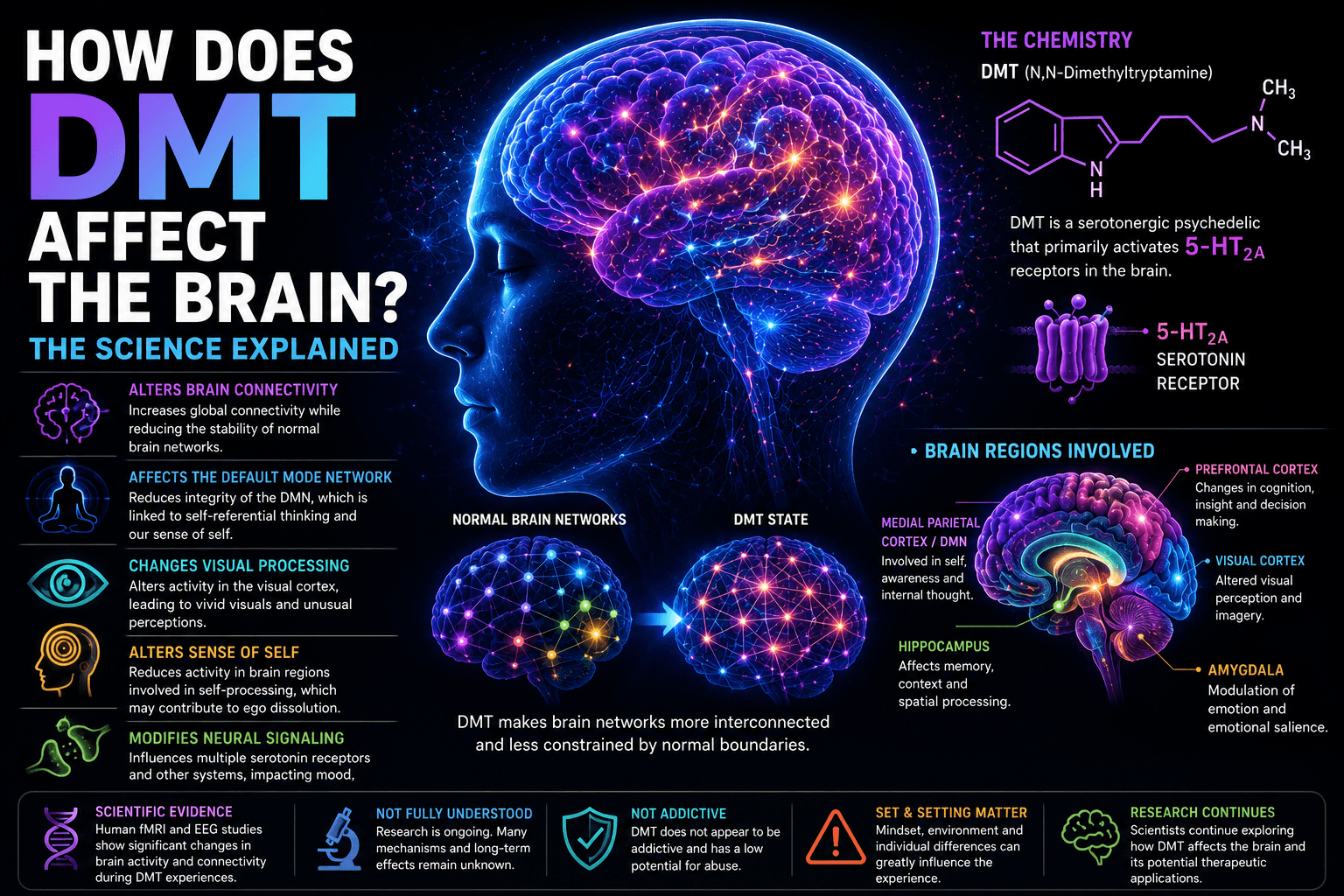
How does DMT affect the brain? This question has become increasingly important as scientists use modern brain-imaging technology to investigate one of the most powerful psychedelic experiences known to researchers.
DMT, or N,N-dimethyltryptamine, is a naturally occurring psychedelic compound that can produce rapid and profound changes in perception, emotion, cognition, time awareness, and the sense of self. Although researchers have studied DMT for decades, modern neuroscience has only recently provided more detailed information about what happens inside the human brain during the psychedelic state.
Scientists now use tools such as functional magnetic resonance imaging (fMRI), electroencephalography (EEG), and positron emission tomography (PET) to investigate these effects. As a result, researchers can examine changes in brain connectivity, electrical activity, sensory processing, and communication between different brain networks.
The emerging picture is fascinating.
Rather than simply “turning the brain off,” DMT appears to reorganize how different parts of the brain communicate. Human imaging research has found increased global connectivity alongside reduced integrity or separation within several established brain networks.
In this guide, we’ll explain how DMT affects the brain, what serotonin receptors have to do with the experience, what happens to brain networks, why perception can change so dramatically, and what scientists still do not know.
What Is DMT?
Before examining how DMT affects the brain, it helps to understand what DMT actually is.
DMT stands for N,N-dimethyltryptamine. It belongs to the tryptamine family of psychedelic compounds and shares some structural characteristics with other serotonergic psychedelics.
DMT occurs naturally in various plants and animals. It has also become an important compound in modern psychedelic neuroscience because it can produce a profound altered state of consciousness over a relatively short period under certain research conditions.
Scientists have investigated DMT’s interaction with several receptors and neurotransmitter systems. However, the 5-HT2A serotonin receptor plays a particularly important role in its psychedelic effects.
That receptor connection helps explain why DMT can dramatically change perception and consciousness.
However, receptor activity alone does not tell the whole story.
The human brain contains billions of neurons communicating through complex networks. Therefore, researchers increasingly study not only which receptors DMT activates but also how those interactions change communication across the entire brain.
How Does DMT Affect the Brain Through Serotonin?
One of the most important answers to how does DMT affect the brain involves serotonin.
DMT acts as a serotonergic psychedelic, meaning that it interacts with receptors belonging to the serotonin system. Among these receptors, researchers have paid particular attention to 5-HT2A.
The 5-HT2A receptor exists throughout the cerebral cortex and plays an important role in perception, cognition, and information processing.
When DMT activates this receptor, it can alter the way neural networks process incoming information and communicate with one another.
Researchers believe this mechanism contributes significantly to the psychedelic experience.
However, DMT does not act on only one receptor. Studies have investigated interactions involving several serotonin receptors and other biological targets. Consequently, scientists cannot explain the complete DMT experience through 5-HT2A activity alone.
A 2025 laboratory study further examined DMT’s effects at the human 5-HT2A receptor and provided additional evidence that the compound produces receptor-specific cellular effects.
Therefore, the best current explanation combines receptor pharmacology with changes in large-scale brain networks.
DMT and the 5-HT2A Receptor
The 5-HT2A receptor deserves special attention because it appears repeatedly in psychedelic neuroscience.
Classic psychedelics such as DMT, LSD, and psilocybin interact with this receptor. Researchers have therefore investigated whether 5-HT2A activity can explain common features of psychedelic experiences.
The answer appears to be partly yes.
Brain-imaging research has found that areas with relatively high 5-HT2A receptor density can show strong changes during psychedelic states. In a landmark human DMT EEG-fMRI study, changes in global functional connectivity were associated with regional 5-HT2A receptor density.
This finding is important because it connects three different levels of science:
DMT → receptor activity → changes in brain networks
That connection gives researchers a better framework for understanding why a chemical interaction at the cellular level can produce dramatic changes in conscious experience.
Nevertheless, scientists continue to investigate other receptors and pathways that may contribute to DMT’s effects.
How Does DMT Affect Brain Connectivity?
One of the most interesting discoveries concerns brain connectivity.
The brain does not operate as a collection of isolated regions. Instead, different areas communicate through interconnected networks.
During normal waking consciousness, these networks maintain relatively stable patterns of communication.
DMT appears to disrupt some of that organization while simultaneously increasing communication between areas that do not normally communicate as strongly.
A major 2023 human EEG-fMRI study examined 20 healthy volunteers before, during, and after intravenous DMT administration. Researchers found increases in global functional connectivity, alongside reduced integrity and separation within several established brain networks.
In simpler terms, DMT appeared to make the brain’s normal network organization more flexible.
Instead of each network operating within relatively distinct boundaries, communication became more distributed.
This finding provides an important clue about why psychedelic states can feel so different from ordinary consciousness.
DMT and the Default Mode Network
Another major topic when discussing how DMT affects the brain is the default mode network, commonly called the DMN.
The DMN is a collection of interconnected brain regions involved in processes such as self-related thinking, autobiographical information, internal reflection, and aspects of social cognition.
Researchers have studied the DMN extensively in psychedelic neuroscience because changes in this network often appear during altered states of consciousness.
DMT research suggests that normal patterns of network organization can become less stable during the psychedelic state.
A 2025 review of DMT neuroimaging research described this pattern as involving disruption of default-mode organization alongside increased global integration.
However, it would be misleading to say that DMT simply “switches off” the default mode network.
The actual picture is more complicated.
Researchers observe changes in network integrity, communication, and organization rather than a simple on/off switch.
That distinction matters because the brain continues to remain highly active during the psychedelic experience.
Does DMT Make the Brain More Connected?
In some ways, yes.
Human imaging research has found increased global functional connectivity during DMT administration.
However, the phrase “more connected” requires some explanation.
Researchers are not saying that every part of the brain suddenly communicates equally with every other part.
Instead, DMT appears to alter the balance between network segregation and integration.
Normally, the brain separates information into specialized systems while maintaining communication between them.
During the DMT state, some of those boundaries appear to become less rigid.
This increased cross-network communication may help explain unusual combinations of sensory, emotional, cognitive, and self-related experiences.
A 2026 mega-analysis of psychedelic brain-imaging datasets found a broader pattern across several psychedelics, including DMT: increased connectivity between higher-order transmodal networks and sensory networks.
This suggests that altered communication between normally distinct systems may represent a broader feature of psychedelic states.
How Does DMT Affect Visual Processing?
Another important part of how DMT affects the brain involves vision.
DMT can produce dramatic changes in visual perception, including complex imagery, altered spatial perception, unusual patterns, and changes in visual intensity.
Scientists have begun investigating these effects directly.
A 2024 neuroimaging study examined the effects of inhaled DMT on population receptive fields in the brain’s primary visual cortex (V1). Researchers found significant increases in receptive-field size in parts of the peripheral visual field during the DMT condition compared with control conditions.
Why does that matter?
The visual cortex normally processes information from the eyes in an organized manner.
When DMT changes how these neural populations respond, the brain may construct visual information differently.
This provides a potential biological explanation for some of the perceptual distortions reported during DMT experiences.
However, visual effects do not originate entirely in the eyes or visual cortex.
Higher-level brain networks also influence how sensory information becomes a conscious experience.
Therefore, researchers continue to examine interactions between early sensory processing and higher-order association networks.
DMT and the Sense of Self
Perhaps one of the most fascinating questions surrounding how DMT affects the brain concerns the sense of self.
During intense psychedelic experiences, some people report that their normal sense of identity becomes weaker, changes dramatically, or temporarily disappears.
Researchers often refer to aspects of this experience as ego dissolution.
Brain-imaging findings provide several possible explanations.
Changes in medial parietal regions, including areas involved in self-related processing, have been observed during DMT research.
A study involving 14 healthy volunteers found a DMT-related brain state characterized by deactivation in medial parietal and hippocampal regions, alongside increased activity in the superior temporal lobe. The researchers also linked these dynamic brain changes with altered experiences of time, space, and self.
These findings do not prove that one specific brain region “creates” the sense of self.
Instead, they suggest that the experience of self depends on coordinated activity across several interacting brain systems.
When those systems reorganize, subjective identity may also change.
DMT, Memory, and the Hippocampus
The hippocampus plays an important role in memory formation, spatial processing, and contextual information.
Researchers have therefore become interested in what happens to hippocampal activity during psychedelic states.
Recent DMT neuroimaging research found dynamic changes involving the hippocampus during the acute psychedelic state.
These findings may help explain why DMT experiences can involve unusual memories, altered spatial sensations, or changes in the perception of familiar environments.
However, scientists do not yet have enough evidence to say exactly how DMT affects memory formation in everyday life.
Most human brain studies involve carefully controlled laboratory conditions and relatively small samples.
Consequently, researchers need larger studies before making strong claims about long-term memory effects.
How Does DMT Affect Brain Waves?
Researchers also use EEG, or electroencephalography, to examine electrical activity in the brain.
EEG measures electrical signals produced by coordinated neural activity.
DMT can alter several characteristics of brain electrical activity during the psychedelic state.
The 2023 EEG-fMRI study found that major EEG changes correlated with changes in fMRI measurements, providing evidence that changes in electrical activity and large-scale connectivity occur together during DMT experiences.
More recent research has continued to examine the relationship between neural dynamics and subjective experience.
A 2026 study involving 19 participants found rapid changes in both subjective experience and EEG features during DMT administration. The researchers found associations between continuous subjective experience and measures including alpha power and permutation entropy.
Interestingly, the study also found that the relationship between neural complexity and subjective experience was less straightforward than some earlier theories suggested.
That finding is important.
It reminds researchers that consciousness cannot be reduced to one simple measure of “brain complexity.”
Does DMT Make the Brain Hyperconnected?
You may encounter the phrase “hyperconnected brain” when researching DMT.
The phrase captures part of the research findings, but scientists need to use it carefully.
DMT can increase global functional connectivity while simultaneously reducing the integrity or segregation of several networks.
Therefore, the brain can become more globally integrated while becoming less organized into its usual network structure.
This combination is one of the most interesting aspects of psychedelic neuroscience.
Imagine the brain as a city.
Normally, different neighborhoods specialize in different activities while major roads connect them.
During a psychedelic state, some neighborhood boundaries may become less distinct while more roads become active between different areas.
That analogy is not a literal description of the brain, but it helps illustrate why researchers describe psychedelic states as involving both integration and desegregation.
DMT and Brain Networks Involved in Emotion
DMT may also influence networks involved in emotion and social cognition.
A 2024 fMRI study involving 11 experienced participants examined connectivity involving the amygdala and posterior supramarginal gyrus during inhaled DMT. Researchers observed increased connectivity between these regions and other areas involved in social cognition, emotional processing, and affective value.
The amygdala plays an important role in emotional processing.
Consequently, changes in communication involving the amygdala could contribute to some of the emotional intensity reported during psychedelic experiences.
However, researchers have not established a simple relationship such as “DMT activates the emotion center.”
Brain function does not work that way.
Instead, DMT appears to influence communication across interconnected systems that participate in perception, emotion, memory, and self-processing.
How Does DMT Affect Consciousness?
This is perhaps the biggest scientific question.
DMT provides researchers with a way to study rapid changes in consciousness under controlled conditions.
During the DMT state, participants can experience profound alterations in perception, time, space, identity, and awareness.
Brain-imaging studies suggest that these experiences correspond with changes in large-scale network organization.
The 2023 EEG-fMRI study found increased global connectivity, reduced network integrity, and compression of the brain’s principal cortical gradient during DMT.
These findings suggest that DMT changes the balance between different levels of information processing.
However, scientists still do not fully understand how changes in neural activity become subjective experiences.
That remains one of the biggest unanswered questions in neuroscience.
Does DMT Permanently Change the Brain?
This question requires particular caution.
Current human research provides strong evidence that DMT produces acute changes in brain function during the psychedelic state.
However, that does not automatically mean that DMT causes permanent structural changes in the brain.
Researchers need longitudinal studies to determine whether repeated exposure produces lasting functional or structural effects.
Much of the current DMT neuroimaging research focuses on the acute period immediately surrounding administration.
Therefore, it would be premature to claim that DMT permanently changes the human brain based on current evidence.
Similarly, it would also be premature to claim that DMT has no long-term neurological effects.
The scientifically responsible position is that long-term effects remain an area requiring additional research.
What Happens to the Brain After DMT?
The acute psychedelic state eventually subsides as DMT is metabolized and its effects decline.
Researchers are increasingly interested in what happens after the acute experience.
Some studies have examined psychological outcomes following controlled DMT exposure. For example, research published in 2024 investigated mental-health outcomes in healthy volunteers following controlled DMT sessions.
However, researchers must distinguish between short-term psychological changes and long-term neurological changes.
A person’s mood or outlook can change after an intense experience without that necessarily indicating permanent changes in brain structure.
Consequently, scientists continue to investigate both immediate and longer-term outcomes.
DMT and Neuroplasticity: What Do Scientists Know?
Neuroplasticity refers broadly to the brain’s ability to change its structure and function in response to experience.
Researchers have become interested in whether psychedelics can influence processes related to neuroplasticity.
Laboratory studies have investigated psychedelic compounds and cellular mechanisms associated with plasticity. However, evidence from laboratory models does not automatically demonstrate that the same effects occur in humans after DMT exposure.
This distinction matters.
A cellular or animal study can provide a valuable mechanism for further investigation, but scientists need well-controlled human studies before drawing conclusions about human neuroplasticity.
Therefore, claims that DMT “rewires the brain” should be treated cautiously.
Current research supports substantial acute changes in brain function, while questions about lasting neuroplastic changes remain under investigation.
Does DMT Affect the Brain Differently From LSD or Psilocybin?
DMT, LSD, and psilocybin all interact with serotonergic systems, particularly 5-HT2A receptors.
Nevertheless, their effects on brain activity are not identical.
A 2026 international mega-analysis compared brain-imaging data from several psychedelics, including DMT, LSD, mescaline, psilocybin, and ayahuasca. Researchers found common changes across psychedelic drugs, particularly increased connectivity between transmodal and sensory networks, while also identifying substance-specific patterns.
This suggests that psychedelic drugs may share some fundamental neural mechanisms while producing distinct experiences.
DMT remains particularly interesting because its acute effects can emerge rapidly and because researchers can observe striking changes in brain dynamics over a relatively short period.
What Does Current DMT Brain Research Tell Us?
Current evidence supports several important conclusions about how DMT affects the brain.
First, DMT strongly influences serotonergic signaling, particularly through the 5-HT2A receptor.
Second, human imaging studies show major changes in functional connectivity during the acute psychedelic state.
Third, DMT can reduce the normal separation between several large-scale brain networks.
Fourth, researchers have observed changes in visual processing that may contribute to altered perception.
Fifth, studies have identified changes in brain regions and networks associated with self-processing, emotion, memory, and consciousness.
Finally, scientists still do not understand every aspect of the DMT experience.
A 2026 mega-analysis provides encouraging evidence that some brain-connectivity changes occur across different psychedelic compounds, but it also shows why researchers need to distinguish shared psychedelic mechanisms from compound-specific effects.
Why More DMT Brain Research Is Needed
Although modern neuroscience has provided valuable information, researchers still face several limitations.
Many DMT brain studies involve relatively small groups of healthy volunteers.
Researchers also use different administration methods, imaging techniques, doses, and experimental designs.
Furthermore, brain imaging provides correlations between brain activity and subjective experience. It does not automatically prove that a specific brain change directly causes a specific psychological effect.
For example, researchers can observe changes in the default mode network during DMT. However, that observation alone cannot prove that the network change directly causes ego dissolution.
Scientists need converging evidence from pharmacology, neuroimaging, behavioral experiments, and carefully controlled clinical research.
Fortunately, the field continues to develop.
Final Thoughts: How Does DMT Affect the Brain?
So, how does DMT affect the brain?
The current evidence suggests that DMT produces profound changes at several levels.
At the molecular level, DMT interacts with serotonin receptors, particularly 5-HT2A.
At the network level, human imaging studies show increased global connectivity and reduced segregation within several established brain networks.
At the sensory level, researchers have observed changes in visual processing that may help explain the striking perceptual effects associated with DMT.
At the psychological level, DMT can dramatically alter the perception of time, space, identity, emotion, and consciousness.
Most importantly, researchers increasingly view the DMT experience as a reorganization of brain dynamics, rather than simply an increase or decrease in overall brain activity.
However, important questions remain unanswered.
Scientists still need to determine how acute neural changes relate to subjective experiences, how long any measurable changes persist, and whether DMT has lasting effects on brain function or structure.
For readers who want to understand DMT from the beginning, visit Portal Chocolate Bars and read our What Is DMT?guide as part of our growing DMT education series.
As psychedelic neuroscience develops, new imaging studies will continue to refine our understanding of how DMT changes the brain and why those changes can produce such unusual states of consciousness.
Frequently Asked Questions About How DMT Affects the Brain
1. How does DMT affect the brain?
DMT affects the brain primarily through interactions with serotonin receptors, especially the 5-HT2A receptor. Human imaging studies also show changes in global connectivity, network organization, visual processing, and brain regions involved in self-related processing and emotion.
2. Does DMT increase brain connectivity?
Research suggests that DMT can increase global functional connectivity while simultaneously reducing the normal segregation and integrity of several brain networks. Therefore, the brain becomes more globally integrated in some respects while its usual organization becomes less distinct.
3. What does DMT do to the default mode network?
DMT can disrupt the normal organization of the default mode network and other large-scale networks. However, scientists do not describe this simply as the network being “turned off.” Instead, research shows changes in network integrity, connectivity, and communication.
4. Does DMT affect serotonin?
Yes. DMT interacts with several serotonin receptors, with 5-HT2A playing a particularly important role in its psychedelic effects. Researchers continue to investigate how these receptor interactions produce changes in perception and consciousness.
5. Does DMT permanently change the brain?
Current research clearly demonstrates acute changes in brain function during DMT experiences. However, scientists do not yet have enough evidence to conclude that DMT causes permanent structural or functional changes in the human brain.
6. Why does DMT change perception so dramatically?
DMT changes activity across several systems involved in sensory processing, brain connectivity, cognition, and consciousness. Research involving the visual cortex has identified changes in neural processing during DMT, while broader imaging studies show major changes in communication between brain networks.
Leave a Reply