
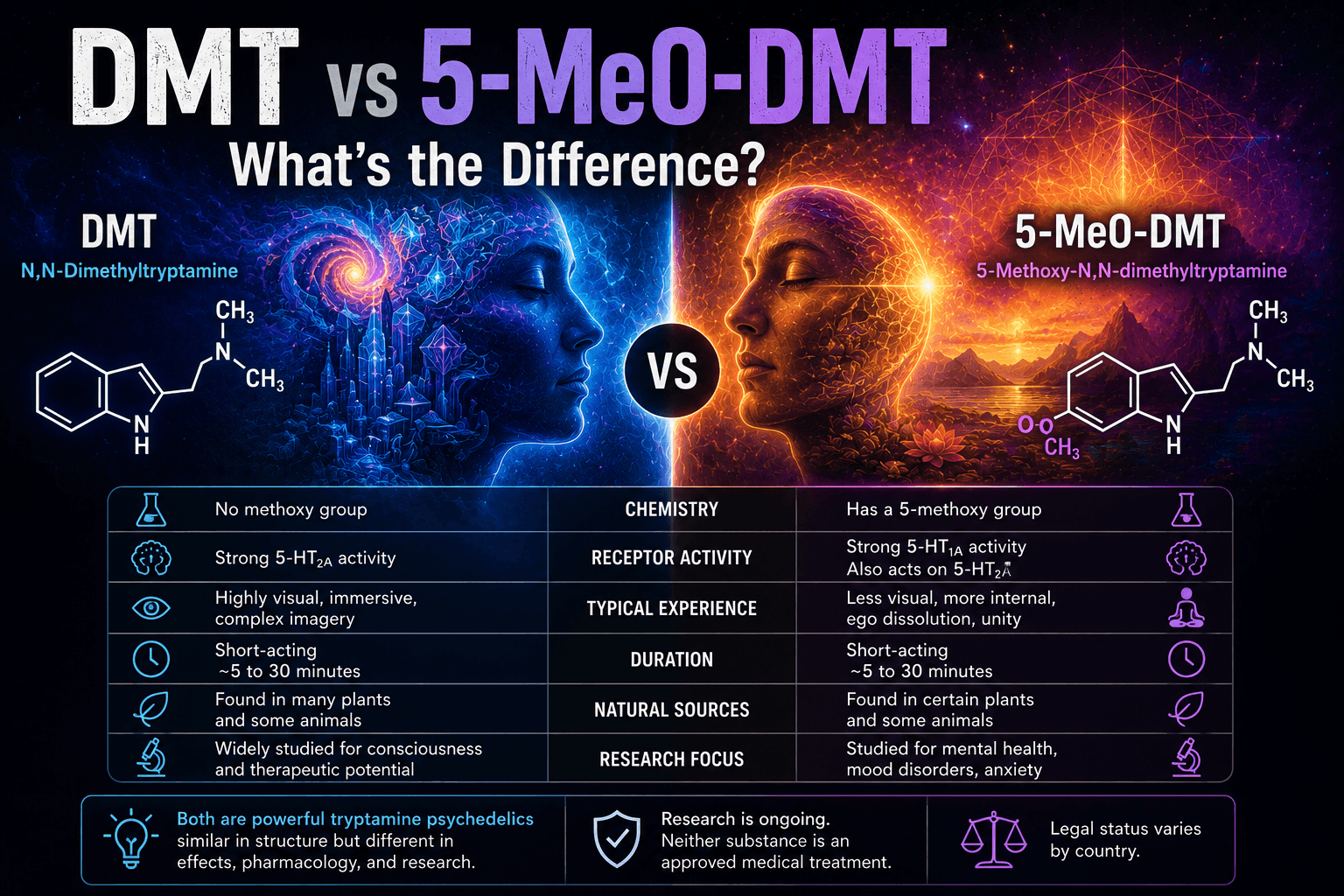
DMT vs 5-MeO-DMT is a common search among people researching psychedelic compounds. Although the names look remarkably similar, these substances are not identical. They have different chemical structures, interact with serotonin receptors somewhat differently, and can produce noticeably different subjective experiences.
Both compounds belong to the tryptamine family of psychedelics. In addition, both occur naturally in some plants and animals and have attracted growing scientific interest because researchers are investigating their effects on consciousness, brain function, and potential therapeutic applications.
However, the similarities can cause confusion.
DMT usually refers to N,N-dimethyltryptamine, while 5-MeO-DMT refers to 5-methoxy-N,N-dimethyltryptamine. The additional methoxy group in 5-MeO-DMT changes its pharmacological properties and receptor profile.
So, what is the actual difference between DMT and 5-MeO-DMT?
This guide compares DMT vs 5-MeO-DMT by looking at their chemistry, receptor activity, subjective effects, duration, natural sources, research, potential risks, and current scientific understanding.
What Is DMT?
DMT stands for N,N-dimethyltryptamine. It is a naturally occurring tryptamine that researchers have identified in various plants and animals.
DMT has a long history of association with traditional plant preparations, particularly ayahuasca. Modern scientists have also studied isolated DMT to understand its pharmacology and effects on consciousness.
Researchers generally associate DMT’s psychedelic activity strongly with the serotonin 5-HT2A receptor. However, DMT interacts with several receptor systems, so its effects cannot be explained by a single receptor alone.
DMT can produce profound alterations in perception, emotions, cognition, time awareness, and the sense of self. Consequently, researchers consider it one of the most intense short-acting classic psychedelics.
If you want a more detailed introduction, read our previous guide, What Is DMT? A Complete Guide to N,N-Dimethyltryptamine.
What Is 5-MeO-DMT?
5-MeO-DMT stands for 5-methoxy-N,N-dimethyltryptamine.
At first glance, the name looks almost identical to DMT. However, the additional methoxy group at the 5-position of the molecule produces important differences in pharmacology.
Researchers describe 5-MeO-DMT as a naturally occurring, short-acting psychedelic tryptamine. Studies indicate that it interacts particularly strongly with the serotonin 5-HT1A receptor, while also acting at 5-HT2A and other targets.
As a result, researchers have described its subjective profile as different from the typical visual-heavy descriptions associated with N,N-DMT.
5-MeO-DMT has also attracted attention in psychedelic research because scientists are investigating its possible effects on depression, anxiety, and other mental-health conditions.
However, these applications remain an active area of research rather than established medical treatment.
DMT vs 5-MeO-DMT: The Basic Difference
The simplest way to understand DMT vs 5-MeO-DMT is to start with their chemical structures.
DMT: N,N-dimethyltryptamine
5-MeO-DMT: 5-methoxy-N,N-dimethyltryptamine
The second compound contains an additional methoxy group.
That small structural difference matters because chemical structure influences how a compound interacts with receptors, how the body metabolizes it, and how it affects the nervous system.
Both compounds interact with serotonin receptors. Nevertheless, 5-MeO-DMT has a particularly strong relationship with 5-HT1A, while N,N-DMT is more strongly associated with 5-HT2A activity.
Therefore, although both belong to the same broad psychedelic family, scientists should not treat them as interchangeable.
DMT vs 5-MeO-DMT: How Do They Affect the Brain?
The brain provides one of the most important differences when comparing DMT vs 5-MeO-DMT.
DMT primarily produces psychedelic effects through interactions with serotonergic systems, particularly the 5-HT2A receptor. Activation of this receptor can alter sensory processing, cognition, perception, and consciousness.
5-MeO-DMT also activates 5-HT2A but shows particularly strong activity at 5-HT1A.
Researchers believe this difference may help explain some of the differences in subjective experiences between the two compounds.
However, scientists still do not understand every mechanism involved.
The brain contains complex networks of receptors, neurons, and signaling pathways. Therefore, researchers cannot simply attribute the entire psychedelic experience to one receptor.
A 2024 structural pharmacology study examined how 5-MeO-DMT interacts with the 5-HT1A receptor at a molecular level. The research helped clarify why 5-methoxytryptamines can produce distinctive receptor activity compared with other serotonergic psychedelics.
In other words, the molecular difference between these compounds has meaningful consequences for their pharmacology.
DMT vs 5-MeO-DMT: What Do the Experiences Feel Like?
The subjective difference is another major part of the DMT vs 5-MeO-DMT discussion.
N,N-DMT is commonly associated with extremely vivid visual experiences. Scientific studies and participant reports describe dramatic changes in visual perception, sensory processing, time perception, emotions, and the sense of self.
People participating in DMT research can report complex imagery and highly immersive altered states of consciousness.
5-MeO-DMT can also produce profound changes in consciousness, but researchers often describe its experience differently.
Research reviews have associated 5-MeO-DMT with strong emotional amplification, altered time and auditory perception, and pronounced changes in the sense of self. Studies also frequently discuss ego dissolution and mystical-type experiences.
Therefore, one useful general distinction is:
DMT is often associated with highly visual and immersive psychedelic experiences, while 5-MeO-DMT is often associated with profound alterations in self-awareness, emotional intensity, and consciousness.
However, these descriptions represent general patterns rather than guarantees.
Individual experiences can vary significantly.
Does 5-MeO-DMT Produce Visual Effects Like DMT?
This is one of the most common questions about DMT vs 5-MeO-DMT.
Both substances can alter perception, but researchers have frequently described 5-MeO-DMT as producing fewer or less prominent visual effects than N,N-DMT.
A review of 5-MeO-DMT research described the compound as having a relatively distinct phenomenological profile, including fewer visual effects and higher rates of reported ego dissolution and mystical-type experiences compared with typical psychedelic experiences.
By contrast, N,N-DMT has become well known for intense visual alterations and complex imagery.
Still, people should not treat this distinction as absolute.
Both substances can produce powerful perceptual changes, and individual responses vary.
DMT vs 5-MeO-DMT: Which One Lasts Longer?
Both DMT and 5-MeO-DMT are considered short-acting psychedelics, although their precise time courses depend on the formulation and route studied.
N,N-DMT undergoes rapid metabolism. A 2025 systematic review of human DMT pharmacokinetics found a reported half-life of approximately 4.8 to 19 minutes across the clinical studies included in the review.
5-MeO-DMT also has a relatively short duration in clinical research.
A recent systematic review of psychedelic pharmacokinetics included both DMT and 5-MeO-DMT and found that available human pharmacokinetic data remain much more limited for 5-MeO-DMT than for some better-studied psychedelics.
Consequently, researchers should avoid presenting one fixed duration as universal.
Importantly, half-life is not the same thing as subjective duration. Half-life describes the decline of a substance’s concentration, while subjective duration describes how long noticeable effects are experienced.
DMT vs 5-MeO-DMT: Natural Sources
Both compounds occur naturally, although their natural sources differ.
Researchers have identified N,N-DMT in numerous plant species and have also investigated its occurrence in animals.
5-MeO-DMT occurs naturally in certain plant species and has also been identified in the secretions of some animals.
The latter association has received considerable attention in popular discussions about 5-MeO-DMT.
However, scientific literature emphasizes that the natural occurrence of a compound does not automatically establish its safety, legality, or appropriate use.
Natural and synthetic forms can also involve different concentrations, impurities, formulations, or biological contexts.
Therefore, researchers treat the chemical compound and its source as separate questions.
DMT vs 5-MeO-DMT and Ayahuasca
People sometimes confuse DMT, 5-MeO-DMT, and ayahuasca because all three appear in discussions about traditional or modern psychedelic practices.
However, they are not the same thing.
DMT is a chemical compound.
5-MeO-DMT is a different chemical compound.
Ayahuasca is a traditional plant-based preparation that can contain N,N-DMT along with other compounds.
Typical ayahuasca chemistry involves DMT-containing plants and plants containing beta-carbolines that affect monoamine oxidase activity.
5-MeO-DMT does not simply represent another form of DMT found in ordinary ayahuasca preparations.
Therefore, anyone researching these substances should keep their chemical identities separate.
DMT vs 5-MeO-DMT: Potential Therapeutic Research
Modern psychedelic research has increased interest in both compounds.
Researchers are investigating N,N-DMT as a possible candidate for controlled psychedelic therapy and as a tool for studying consciousness.
5-MeO-DMT has also attracted considerable attention because early research suggests possible effects on depression, anxiety, and other mental-health outcomes.
However, the evidence remains preliminary.
A comparative review of serotonergic psychedelics noted that clinical evidence for therapeutic applications remains limited for several compounds, including DMT and 5-MeO-DMT.
Similarly, reviews of 5-MeO-DMT research have emphasized the need for more controlled clinical trials.
Therefore, it would be inaccurate to describe either compound as an established treatment for depression or another medical condition.
Researchers need larger randomized studies, longer follow-up periods, and better safety data before drawing firm conclusions.
DMT vs 5-MeO-DMT: Safety and Risks
Both compounds can produce intense psychological and physiological effects.
DMT research has documented temporary cardiovascular changes such as increases in heart rate and blood pressure. Researchers have also reported psychological effects that can include anxiety, confusion, fear, or emotional overwhelm.
5-MeO-DMT can also produce powerful psychological effects and physiological changes.
Research reviews emphasize the importance of controlled conditions and careful participant screening.
This matters because clinical trials differ substantially from uncontrolled environments.
Researchers carefully select participants, monitor physiological measures, establish procedures for responding to adverse events, and exclude people for whom the study may present unacceptable risks.
Consequently, positive findings from clinical research should not be interpreted as evidence that either compound is universally safe.
DMT vs 5-MeO-DMT: Drug Interactions
Drug interactions represent another important difference and similarity when considering DMT vs 5-MeO-DMT.
Both compounds affect serotonergic systems. Consequently, combining serotonergic psychedelics with certain medications or psychoactive substances may create unpredictable risks.
Research on 5-MeO-DMT has specifically examined interactions involving monoamine oxidase inhibitors and other serotonergic mechanisms.
Because serious interactions can depend on the specific medication, medical condition, and combination involved, people should not rely on general internet advice when assessing personal risk.
Anyone taking prescription medication or managing a medical or psychiatric condition should discuss potential interactions with a qualified healthcare professional.
DMT vs 5-MeO-DMT: Are They the Same Compound?
No.
This is perhaps the most important answer in the entire DMT vs 5-MeO-DMT comparison.
Although both compounds belong to the tryptamine family and share part of their chemical name, they are chemically distinct substances.
N,N-DMT contains the basic dimethyltryptamine structure.
5-MeO-DMT contains an additional methoxy group.
That difference changes receptor binding, pharmacology, metabolism, and subjective effects.
Therefore, calling 5-MeO-DMT simply “DMT” can create confusion.
When reading scientific literature, product labels, research papers, or educational material, it is important to distinguish N,N-DMT from 5-MeO-DMT.
DMT vs 5-MeO-DMT: Key Differences at a Glance
| Feature | DMT | 5-MeO-DMT |
|---|---|---|
| Full name | N,N-dimethyltryptamine | 5-methoxy-N,N-dimethyltryptamine |
| Chemical family | Tryptamine | Tryptamine |
| Main receptor emphasis | Strong 5-HT2A activity | Stronger 5-HT1A activity, plus 5-HT2A |
| Typical research description | Highly visual, immersive psychedelic effects | Strong alterations in self, emotion, and consciousness |
| Visual effects | Often prominent | Often less prominent |
| Duration | Short-acting | Short-acting |
| Natural occurrence | Plants and animals | Plants and some animals |
| Research status | Active clinical research | Active but smaller clinical evidence base |
| Established medical treatment? | No | No |
This table provides a simplified comparison. Real pharmacology is more complicated because both substances interact with multiple biological targets.
Why Do People Confuse DMT and 5-MeO-DMT?
The names create most of the confusion.
Both names contain DMT, and both belong to the tryptamine family. Furthermore, both can produce intense psychedelic experiences and interact with serotonin receptors.
However, the prefix 5-MeO represents a meaningful chemical modification.
Think of the compounds as close chemical relatives rather than identical substances.
Their similarities explain why scientists study them together, while their differences explain why researchers continue to compare their receptor profiles, subjective effects, pharmacokinetics, and therapeutic potential.
What Does Current Research Say About DMT vs 5-MeO-DMT?
Current research supports several broad conclusions.
First, both compounds are short-acting serotonergic psychedelics.
Second, both can produce profound changes in consciousness.
Third, their receptor profiles differ, particularly regarding the relative importance of 5-HT1A and 5-HT2A signaling.
Fourth, researchers have observed differences in subjective effects, with N,N-DMT more strongly associated with complex visual phenomena and 5-MeO-DMT more strongly associated with ego dissolution and changes in self-related experience.
Finally, both compounds remain under investigation for possible therapeutic applications.
A 2024 comparative review emphasized that researchers still need more evidence to determine how differences in receptor profiles translate into different therapeutic outcomes.
More recent pharmacology research continues to investigate these distinctions at the molecular and clinical levels.
Therefore, the scientific story is still developing.
Which Is More Powerful: DMT or 5-MeO-DMT?
There is no scientifically useful single answer to whether DMT or 5-MeO-DMT is “more powerful.”
Intensity depends on multiple factors, including the compound, formulation, individual biology, experimental conditions, and the specific aspect of the experience being measured.
For example, one person may describe intense visual effects as the most powerful part of a psychedelic experience, while another may consider profound changes in self-awareness more significant.
Researchers therefore use standardized psychological and physiological measures rather than relying on a simple “stronger versus weaker” ranking.
The important point is that DMT and 5-MeO-DMT can both produce extremely intense experiences, but they can do so in different ways.
Final Thoughts on DMT vs 5-MeO-DMT
The comparison between DMT vs 5-MeO-DMT becomes much clearer once their chemical structures and receptor profiles are separated.
N,N-DMT and 5-MeO-DMT are related tryptamine psychedelics, but they are not the same substance.
DMT is strongly associated with 5-HT2A activity and is often described in research as producing vivid visual and immersive psychedelic effects. 5-MeO-DMT has particularly strong 5-HT1A activity and often produces a different subjective profile, including profound changes in self-awareness and emotional experience.
Both compounds act relatively quickly and have short-acting profiles. Nevertheless, their pharmacology, metabolism, subjective effects, and research profiles differ.
Importantly, scientists are still learning about both substances. Current clinical research remains relatively limited, particularly compared with better-established areas of psychedelic research.
For that reason, readers should distinguish established findings from early hypotheses and personal anecdotes.
If you want to learn more about N,N-DMT, read our previous What Is DMT? A Complete Guide to N,N-Dimethyltryptamine article. You can also explore more educational information from Portal Chocolate Bars as we continue building our DMT research and education series.
Frequently Asked Questions About DMT vs 5-MeO-DMT
1. Is DMT the same as 5-MeO-DMT?
No. DMT usually refers to N,N-dimethyltryptamine, while 5-MeO-DMT means 5-methoxy-N,N-dimethyltryptamine. They are chemically related but distinct compounds with different pharmacological profiles.
2. What is the main difference between DMT and 5-MeO-DMT?
The main differences involve their chemical structures, receptor activity, and subjective effects. DMT has strong 5-HT2A activity and is often associated with vivid visual experiences, while 5-MeO-DMT has particularly strong 5-HT1A activity and is often associated with profound changes in self-awareness and consciousness.
3. Does 5-MeO-DMT produce visuals like DMT?
Generally, research reviews describe 5-MeO-DMT as producing fewer or less prominent visual effects than N,N-DMT. However, both compounds can produce significant perceptual changes, and individual experiences vary.
4. Which lasts longer, DMT or 5-MeO-DMT?
Both are considered short-acting psychedelics, although their exact time courses depend on the route and formulation studied. Researchers continue to investigate their pharmacokinetic differences.
5. Are DMT and 5-MeO-DMT being studied for medical use?
Yes. Researchers are investigating both compounds for potential therapeutic applications, particularly in mental-health research. However, the clinical evidence remains preliminary, and neither compound should be considered an established treatment based solely on current research.
6. Why are DMT and 5-MeO-DMT often confused?
Their names are very similar, and both belong to the tryptamine family of psychedelics. However, 5-MeO-DMT contains an additional methoxy group that produces important differences in receptor activity and pharmacology.
Leave a Reply