
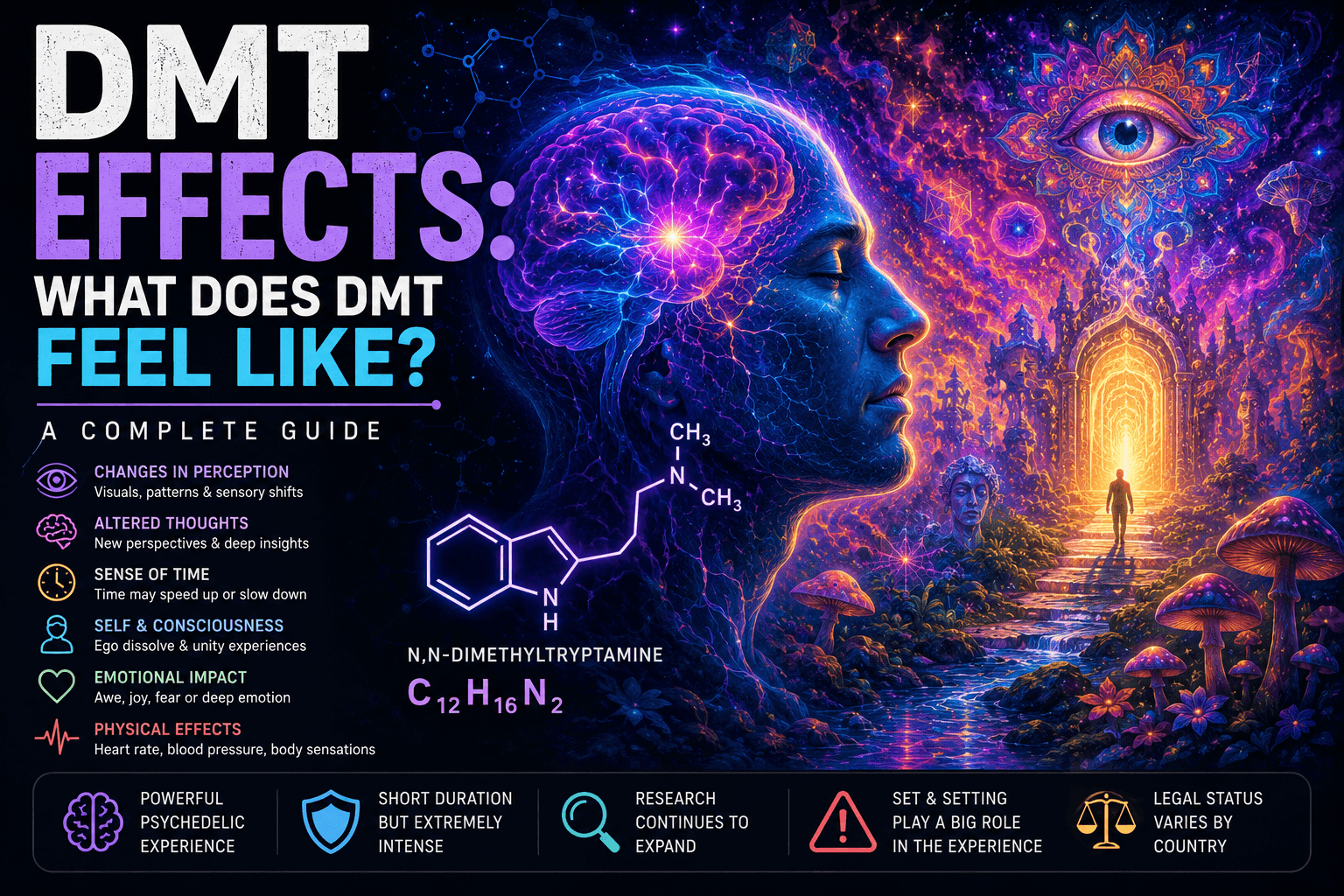
DMT, or N,N-dimethyltryptamine, is a powerful psychedelic compound that can produce profound changes in perception, emotions, thoughts, and the sense of self. As interest in psychedelic science continues to grow, more people are searching for reliable information about DMT effects and what researchers actually know about the experience.
Unlike many substances that produce relatively predictable effects, DMT can affect people differently. Some research participants report intense visual experiences and major changes in their perception of time and space. Others describe powerful emotional or mystical experiences. At the same time, some people can experience anxiety, confusion, physical discomfort, or an overwhelming psychological response.
Therefore, it is important to separate scientific evidence from stories and exaggerated claims found online.
This guide explains the DMT effects researchers have documented, how DMT can influence perception and consciousness, how long effects may last, possible physical and psychological effects, current safety research, and why individual experiences can vary.
What Are DMT Effects?
DMT effects refer to the physical, psychological, perceptual, and emotional changes associated with exposure to N,N-dimethyltryptamine.
DMT belongs to the tryptamine family of psychedelic compounds. Researchers have linked its psychedelic activity to several serotonin receptors, particularly the 5-HT2A receptor. This receptor plays an important role in perception, cognition, and consciousness.
As a result, DMT can produce dramatic changes in how a person experiences their surroundings and their own thoughts.
Commonly reported DMT effects include:
- Changes in visual perception
- Intensified colors and patterns
- Distorted perception of time
- Changes in body awareness
- Altered sense of self
- Rapid changes in thoughts
- Intense emotional experiences
- Feelings of awe or unusual significance
- Auditory or sensory alterations
- Confusion or anxiety in some circumstances
However, these effects do not occur identically in everyone.
The scientific literature also shows that the intensity and character of DMT experiences can vary considerably between individuals and research settings.
How Does DMT Affect Perception?
One of the most noticeable DMT effects involves perception.
DMT can dramatically change the way the brain processes sensory information. People participating in research have reported significant alterations in visual perception, spatial awareness, time perception, and their interpretation of their surroundings.
For example, a person may experience complex visual imagery or unusual patterns. In addition, ordinary surroundings may seem completely different from their normal appearance.
Researchers use questionnaires such as the Five Dimensions of Altered States of Consciousness Questionnaire and the Hallucinogen Rating Scale to measure these changes in controlled studies.
A 2025 randomized, double-blind clinical trial involving 25 healthy participants found that DMT significantly increased measures of subjective intensity and altered states of consciousness compared with an active placebo. Researchers also observed changes across several dimensions of the psychedelic experience.
These findings support what researchers have observed in earlier psychedelic studies: DMT can produce substantial changes in conscious experience.
DMT Effects on Time Perception
Another commonly discussed aspect of DMT effects involves time.
During an intense psychedelic experience, a person’s perception of time may change dramatically. A short period can feel much longer, while events can appear to happen extremely quickly.
This difference between objective time and subjective time is important.
Researchers distinguish between the actual pharmacological duration of a substance and the way a participant experiences that period. Therefore, a short-acting compound can still produce an experience that feels highly immersive.
DMT’s rapid metabolism makes this especially interesting to researchers. A 2025 systematic review of human pharmacokinetic research found that DMT has a relatively short half-life, ranging from approximately 4.8 to 19 minutesacross the clinical studies reviewed.
However, a pharmacokinetic half-life does not tell us exactly how long subjective effects feel to an individual.
DMT Effects on Emotions
DMT can also produce powerful emotional changes.
Some people describe feelings of wonder, awe, joy, connectedness, or emotional intensity. However, not every experience feels positive.
Research participants can also experience fear, anxiety, confusion, or emotional overwhelm. Consequently, researchers carefully monitor participants during controlled clinical studies.
A 2025 clinical trial found that DMT produced strong subjective effects while researchers monitored participants’ physiological responses and adverse events. The reported adverse events were predominantly mild and transient within that controlled study.
This does not mean that DMT produces the same emotional response for everyone.
Instead, it demonstrates why researchers evaluate psychological effects alongside physical safety.
DMT Effects on the Sense of Self
One of the most distinctive psychological effects associated with DMT involves changes in the perception of identity and self.
Some research participants report a weakened or altered sense of their normal identity. Researchers sometimes describe this phenomenon using terms such as ego dissolution.
During an intense psychedelic state, the usual boundaries between the self and the surrounding environment can feel different.
Some people interpret this experience spiritually or philosophically. However, scientists generally avoid treating personal interpretations as objective evidence about consciousness or reality.
Instead, researchers measure the experience and investigate what happens in the brain and behavior during and after the altered state.
This distinction matters because personal accounts can provide valuable descriptions of subjective experiences, but they cannot independently establish scientific explanations.
Physical DMT Effects
DMT does not only affect perception and psychology. It can also produce measurable physical changes.
Research has reported temporary changes in cardiovascular measures, including heart rate and blood pressure.
Other physical DMT effects reported in clinical research can include:
- Nausea
- Dizziness
- Changes in breathing or respiratory sensations
- Throat or respiratory irritation in some inhalation studies
- Temporary increases in heart rate
- Temporary increases in blood pressure
- Changes in body awareness
A 2025 systematic review examined five early-phase clinical trials involving DMT in healthy volunteers and people with major depressive disorder. The review found temporary increases in blood pressure and heart rate in intravenous studies at higher exposures, while other studies reported effects such as mild nausea, dizziness, and respiratory irritation.
Importantly, the authors emphasized that the evidence remains limited and that larger controlled studies are necessary.
Why DMT Effects Can Feel So Intense
Scientists continue to investigate why DMT can produce such powerful changes in consciousness.
One important factor involves serotonin signaling.
DMT interacts with the 5-HT2A receptor, which plays a significant role in psychedelic effects. However, DMT interacts with more than one biological target, so researchers continue to investigate the full picture.
The brain also processes sensory information through complex networks rather than a single pathway. Therefore, changing activity across several systems can potentially alter perception, attention, emotion, memory, and the sense of self at the same time.
Researchers still do not have a complete explanation for every aspect of the DMT experience.
That uncertainty makes DMT an important subject for neuroscience research.
How Long Do DMT Effects Last?
The duration of DMT effects depends on several factors, including the research context and route of administration.
DMT has a reputation for producing a comparatively short psychedelic experience. Researchers have also confirmed that the compound is rapidly metabolized.
In a systematic review of clinical pharmacokinetic studies, researchers analyzed 13 publications covering eight distinct datasets. They reported a DMT half-life of approximately 4.8 to 19 minutes across the studies.
However, people should not interpret those numbers as a precise prediction of subjective experience.
Pharmacokinetics describes how the body absorbs, distributes, metabolizes, and eliminates a compound. Subjective duration describes how long an experience feels.
Those measurements are related, but they are not identical.
For that reason, researchers continue to study both the biological and psychological timelines associated with DMT.
DMT Effects Compared With Other Psychedelics
DMT belongs to the same broad psychedelic family as several other compounds, but its effects do not exactly match those of LSD or psilocybin.
DMT vs. LSD
LSD generally produces a much longer-lasting psychedelic experience than DMT. DMT, by comparison, has a much shorter pharmacokinetic profile in clinical research.
Both compounds can alter perception, cognition, emotions, and sensory processing. However, their chemistry, pharmacology, and time courses differ.
DMT vs. Psilocybin
Psilocybin is converted into psilocin in the body and produces psychedelic effects primarily through serotonergic mechanisms. DMT also interacts strongly with serotonin receptors, particularly 5-HT2A.
However, the experiences and durations differ substantially.
Researchers continue to compare these compounds because controlled studies can help scientists understand which effects they share and which effects remain unique.
Can DMT Effects Be Positive or Negative?
Yes.
The experience can include positive, neutral, frightening, or emotionally difficult elements.
Some participants describe profound personal meaning, awe, connectedness, or unusual insights. Others may experience fear, anxiety, confusion, or psychological distress.
Researchers therefore avoid describing DMT as universally positive or negative.
Instead, they examine the conditions surrounding the experience.
Clinical research provides an important example. Researchers screen participants, establish controlled environments, monitor physiological responses, and use structured assessments. Those conditions differ significantly from uncontrolled environments.
Consequently, findings from clinical trials should not automatically be interpreted as predictions for every possible circumstance.
What Factors Can Influence DMT Effects?
Several factors may influence the character of a psychedelic experience.
These can include:
- Individual differences in brain chemistry
- Previous psychedelic experience
- Psychological state
- Expectations
- Physical environment
- Social environment
- Other substances or medications
- Individual sensitivity
- Medical or psychiatric history
Researchers call attention to these variables because psychedelic experiences are highly subjective.
Furthermore, modern clinical trials often use strict eligibility criteria. A 2026 scoping review of registered DMT and ayahuasca trials found that many studies use conservative eligibility requirements, including extensive cardiovascular and psychiatric exclusions.
This shows how seriously researchers treat individual differences and potential risk factors.
What Does Current Research Say About DMT Effects?
Modern research has moved beyond simply documenting psychedelic experiences.
Scientists now investigate DMT’s pharmacokinetics, subjective effects, physiological responses, brain mechanisms, and possible therapeutic applications.
For example, a 2025 systematic review of early-phase clinical trials examined DMT safety and tolerability in healthy volunteers and people with major depressive disorder. The review included five trials and concluded that early findings were promising but that larger, well-controlled studies remain necessary.
Another 2025 randomized clinical trial studied vaporized DMT under controlled conditions. Researchers found strong subjective effects and temporary physiological changes, while reported adverse events were predominantly mild and transient within the study.
Researchers are also investigating longer-term questions.
For example, scientists want to understand how psychedelic experiences affect cognition, mood, emotional processing, and brain function after the acute effects disappear.
A recent systematic review covering placebo-controlled studies of LSD, DMT, and psilocybin found that effects on cognitive and psychological functions varied depending on the task and timing of assessment. The authors also highlighted the small sample sizes in many studies and the need for larger research.
Therefore, DMT research remains promising but incomplete.
Are DMT Effects Dangerous?
The answer depends on the individual, circumstances, and context.
DMT can produce significant psychological and physiological changes. Therefore, people should not assume that a short duration makes the experience risk-free.
Clinical studies have generally reported manageable adverse events under controlled conditions, but researchers continue to study cardiovascular responses, psychological reactions, medication interactions, and longer-term outcomes.
A systematic review of adverse events associated with classic psychedelics also emphasizes the importance of carefully monitoring physical and psychiatric outcomes in research.
Anyone with medical or psychiatric concerns should speak with a qualified healthcare professional before considering any psychedelic substance.
DMT Effects and the Future of Psychedelic Research
Interest in DMT research continues to grow.
Scientists are particularly interested in DMT because it produces profound alterations in consciousness while also having a relatively short pharmacokinetic profile.
Researchers are now exploring whether those characteristics could make DMT useful for controlled therapeutic research.
However, promising research does not equal established medical treatment.
Scientists still need larger randomized studies, longer follow-up periods, better understanding of individual differences, and more evidence about long-term safety.
As research develops, new findings may change how scientists understand DMT.
For readers who want to explore DMT-related topics, Portal Chocolate Bars provides additional educational content and information about the broader category.
Final Thoughts on DMT Effects
DMT effects can involve dramatic changes in perception, time, emotions, cognition, physical sensations, and the sense of self.
Research shows that DMT interacts with important serotonin receptors and can produce profound altered states of consciousness. At the same time, clinical studies show measurable physiological changes and demonstrate why researchers carefully monitor participants.
Most importantly, science still has unanswered questions.
Researchers continue to investigate how DMT changes brain activity, why experiences vary between individuals, how long different effects persist, and whether DMT could have legitimate therapeutic applications.
For now, the strongest approach is to look at the evidence carefully rather than relying on exaggerated claims or personal anecdotes.
Portal Chocolate Bars will continue to provide educational information about DMT, psychedelic research, and related topics as scientific understanding develops.
Frequently Asked Questions About DMT Effects
1. What are the main DMT effects?
The main DMT effects can include major changes in visual perception, time perception, emotions, thoughts, body awareness, and the sense of self. Physical effects can also include temporary increases in heart rate and blood pressure.
2. How long do DMT effects last?
DMT has a relatively short pharmacokinetic profile compared with some other psychedelics. However, subjective duration can differ from pharmacokinetic measurements. Clinical research has reported a DMT half-life of approximately 4.8 to 19 minutes across the studies included in a 2025 systematic review.
3. Does DMT affect the brain?
Yes. DMT interacts with several receptors in the brain, including the serotonin 5-HT2A receptor. These interactions contribute to changes in perception, cognition, emotions, and consciousness.
4. Can DMT cause anxiety?
Yes. Although some people report positive or meaningful experiences, DMT can also produce anxiety, fear, confusion, or psychological distress. Individual responses can vary considerably.
5. Are DMT effects being studied by scientists?
Yes. Researchers currently study DMT’s safety, pharmacokinetics, subjective effects, brain mechanisms, and possible therapeutic applications. Recent clinical studies have expanded the scientific evidence base, although larger and longer-term studies remain necessary.
6. Are DMT effects the same for everyone?
No. DMT experiences can vary significantly between individuals. Psychological state, environment, individual biology, expectations, medications, and other factors can influence the experience. Researchers therefore avoid treating one person’s experience as representative of everyone.
Leave a Reply